
On April 10, Zoe and I analyzed a basket of 1,000 B2B SaaS SERPs across 250 unique, niche product categories to assess the impact of Google AI Overviews on results.
We found a lot more.
If you’re a B2B SaaS marketer trying to get on enterprise buyers’ shortlists, we made this report for you. (And if you want more hands-on help, drop me a line!)
Here’s what we found looking at the entire index:
- Google AI Overviews (AIOs) appear on 21.8% of niche B2B SaaS SERPS, which is about average.
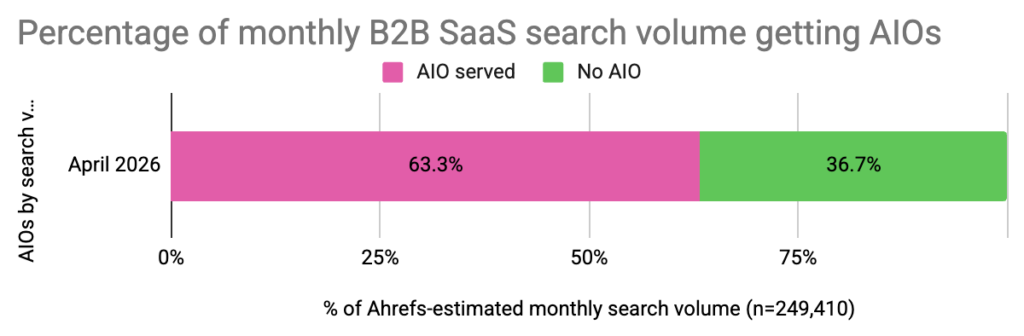
- 63.3% of searches result in AIOs.
- 15.5% of total results are ads.
- 3.6% of total results are in the AIOs.
- 8.3% of total results are links to Reddit.
- 43.9% of total results are organic (61.8% if you lump in accompanying sitelinks).
As far as Google AI Overviews go:
- 27.2% of results contained in AIOs are content marketing pages (blog posts, articles, etc.).
- 12.7% of results contained in AIOs are brand home pages.
- 9.1% of results contained in AIOs are pages on review aggregator sites (Gartner, G2, etc.).
- 4.9% of results contained in AIOs are links to YouTube.
And when it comes to strictly organic results, we saw:
- 31.4% of organic results are content marketing pages (blog posts, articles, etc.).
- 14.8% of organic results are review aggregators (Gartner, G2, etc.).
- 8.4% of organic results are home pages.
- 4.2% of organic results are links to Reddit.
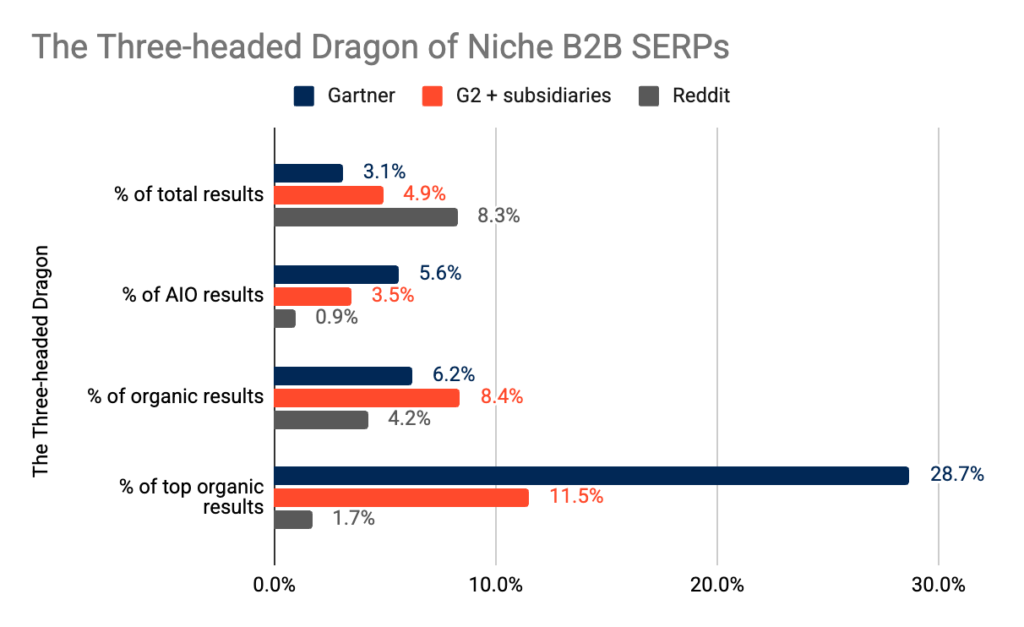
- Gartner holds 28.7%(!) of all the top organic SERP positions.
In addition to analyzing those 1,000 SERPs, we partnered with Amadora, an AI visibility tool for agencies, to analyze responses to 1,000 parallel niche B2B SaaS prompts in ChatGPT, Perplexity, and Gemini. (BIG thank you to Dmitry Chistov for this!)
Which gives us our last stat:
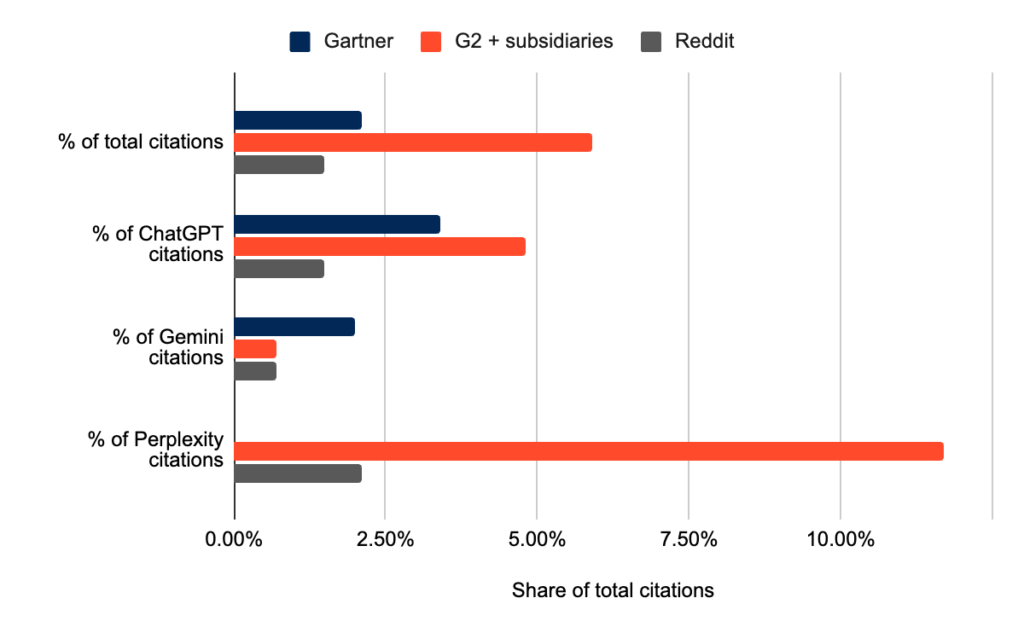
G2 is the #1 cited source in answer generators, representing 4.1% of total citation share.
“Whoa—where’d these numbers come from, Jeffrey?”
About the Niche B2B SaaS SERP Index
For a while now, marketing leaders have been under pressure to figure out how they’re going to handle search in the age of AI. If you’ve felt like that conversation is pulling you in ninety-six directions at once, I feel you.
Most of the SEO community is talking about AI search and visibility at the general level.
That’s kind of like reading about your hometown’s climate on Wikipedia—it gives you the big picture, but it doesn’t tell you if you need to bring an umbrella to work today.
What matters more than the large-scale changes in search is the SERPs in our own product category verticals right now.
So Overthink Group General Manager Zoe Tjoelker and I created our own niche B2B SaaS SERP index. This is a basket of 1,000 SERPs for solution-aware keywords related to 250 niche software product categories from G2’s database. We’re looking specifically at what people see when they Google mid-volume, solution-aware keywords.
Think of this as the local SEO weather report for B2B SaaS.
I’ve described the methodology later in this article, in a minute—first let’s look at the headlines.
AIOs occupy 21.8% of SERPs, favoring high-volume keywords
Only about a fifth of the SERPs in our index (218, to be exact) sport Google AI Overviews. These AIOs include, on average, about 3.4 citation links apiece, and they’re almost always at the very top of the SERP: the average AIO position across the index is 1.08.
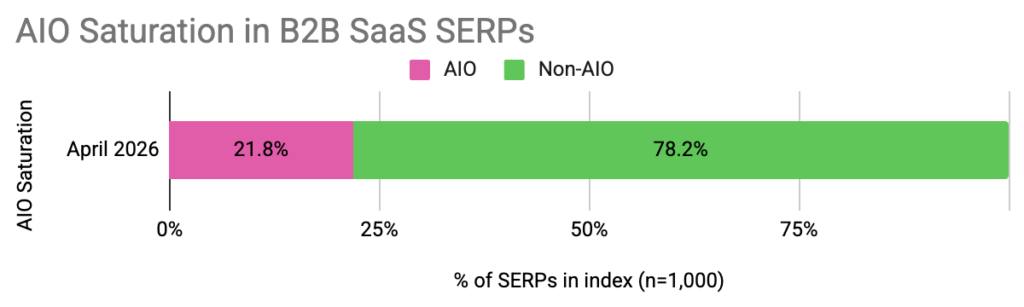
Ahrefs reported almost the same AIO saturation rate for all search in their November study last year, but it’s still higher than Semrush’s December estimate of 15.7%.
This number doesn’t give us the whole picture, though: we also need to know how often these AIOs are getting served. In general, Google puts these on SERPs for higher-volume keywords: across the index, 63.3% of searches will yield a SERP with an AIO.
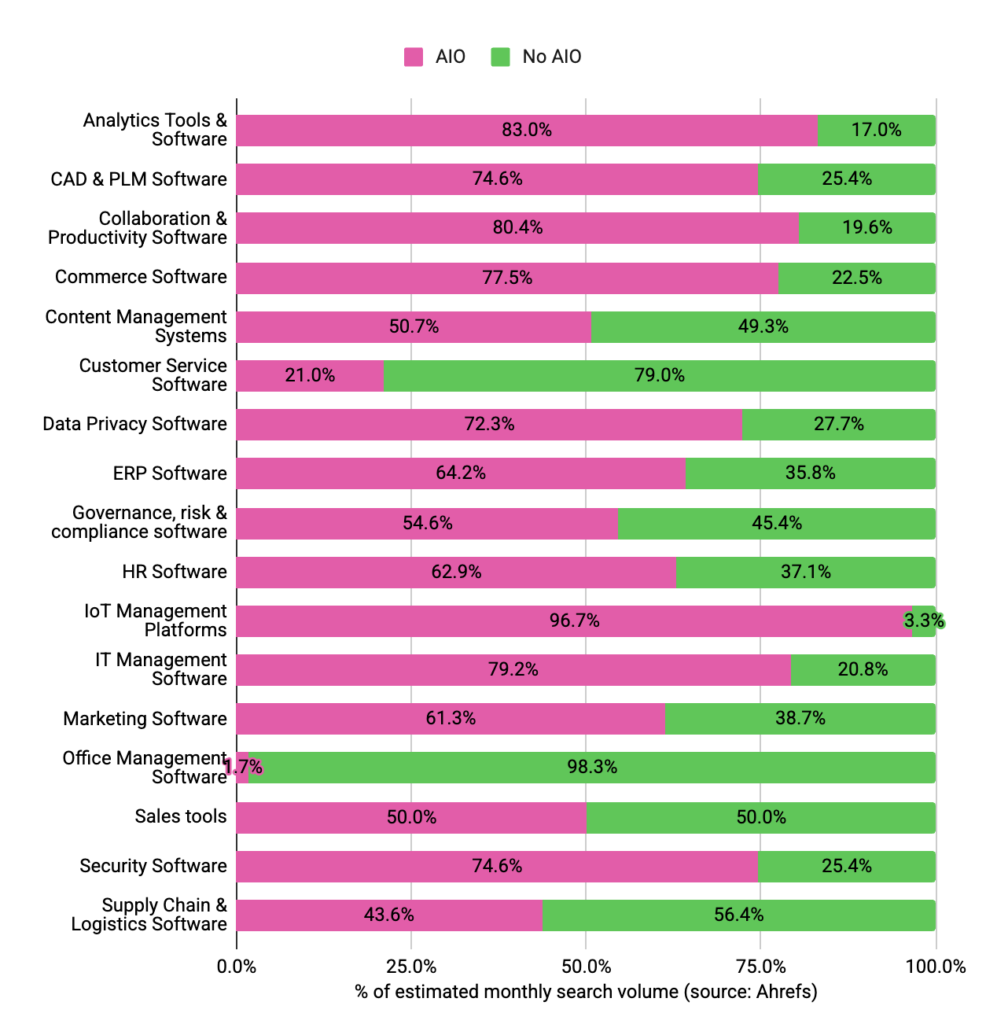
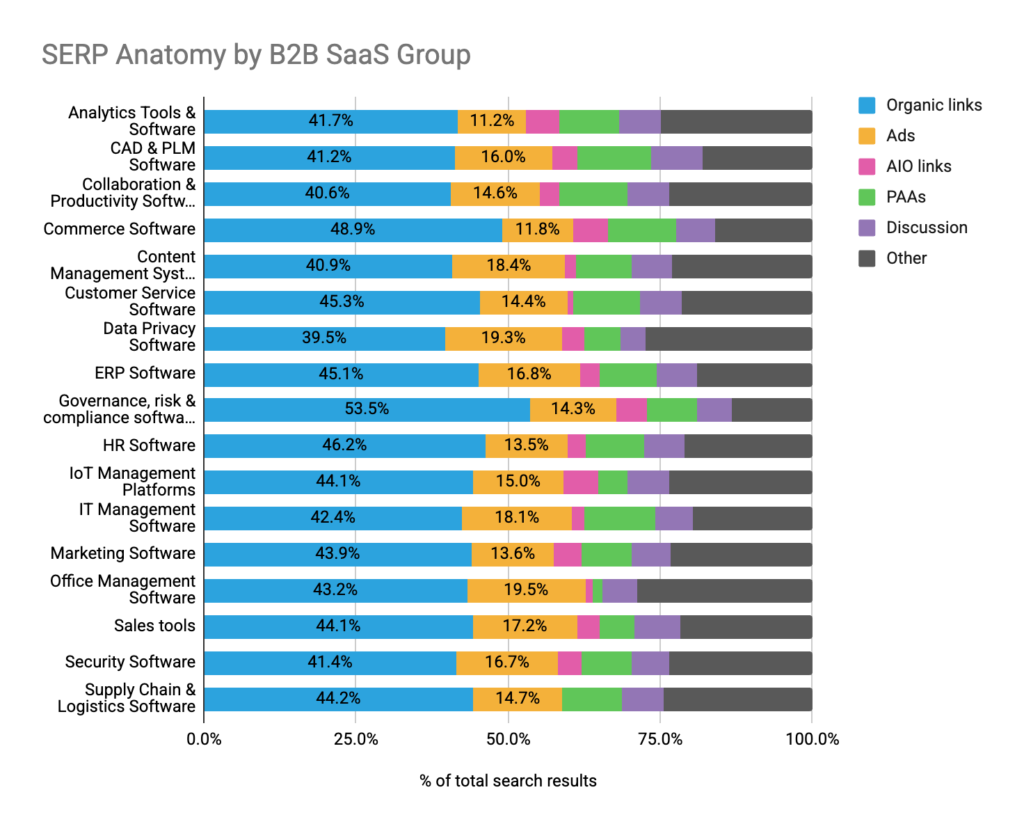
Here’s how that breaks down across the 17 niche B2B SaaS groups:
Organic results are still the majority, but 15.5% of SERP content is paid
It’s not exactly ad-pocalypse, but ads are on the rise. I’m inclined to agree with Tim Soulo’s opinion on why this might be:
“Businesses are losing organic clicks from Google and compensating with ad spend. They have no choice. They still need customers on their websites. So Google pushes AI Overviews, organic traffic drops … and businesses respond by giving Google more money for ads.”
Tim Soulo
CMO, Ahrefs
“True” organic search results make up 43.9% of search results across the index. If you combine that with the sitelinks Google picks out to accompany them, organic content’s SERP share goes up to 61.8%.
Then it’s ads at 15.5%, followed by People Also Ask boxes (8.8%) and Discussions (6.4%). AIOs only account for 3.6% of clickable results.
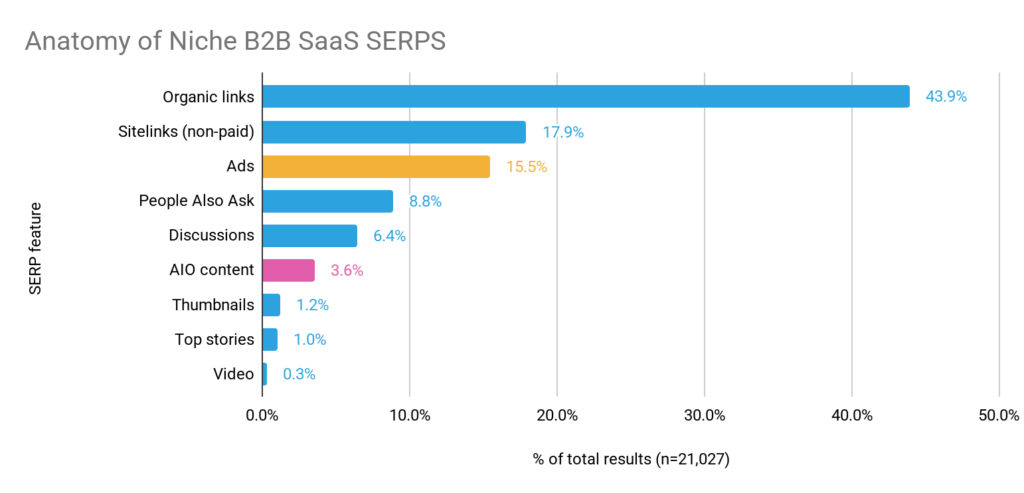
(And in case you’re curious, yes, Reddit dominates the Discussions SERP features. 52.2% of Discussions links go to Reddit.)
However, there’s a decent amount of ad saturation variance when we zoom in on the individual B2B SaaS categories, ranging from 11.2% in analytics tools all the way up to 19.5% in office management.
Reddit is the most-cited domain in Google SERPs
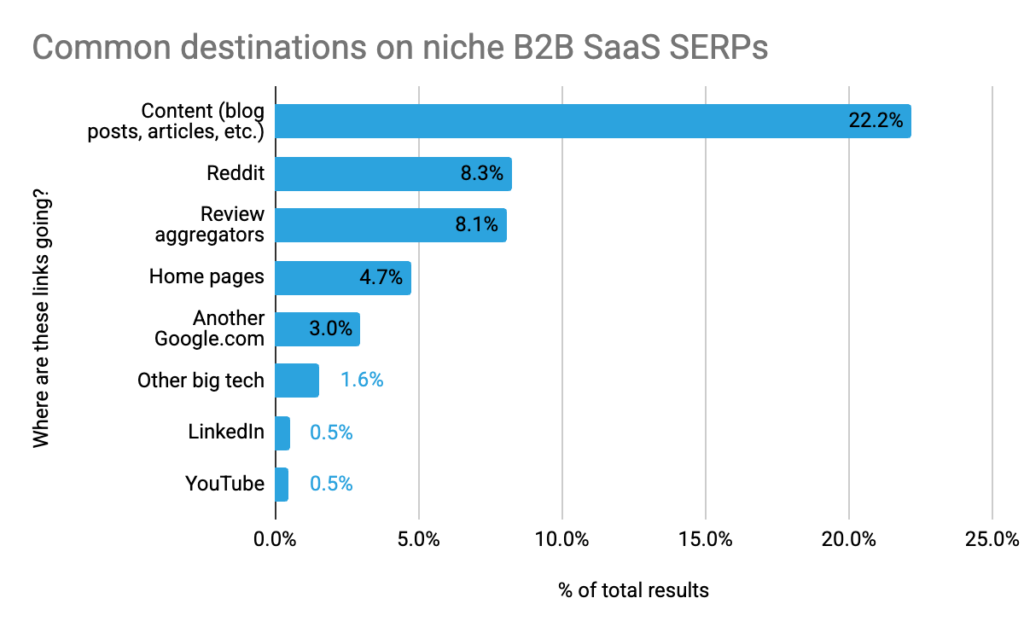
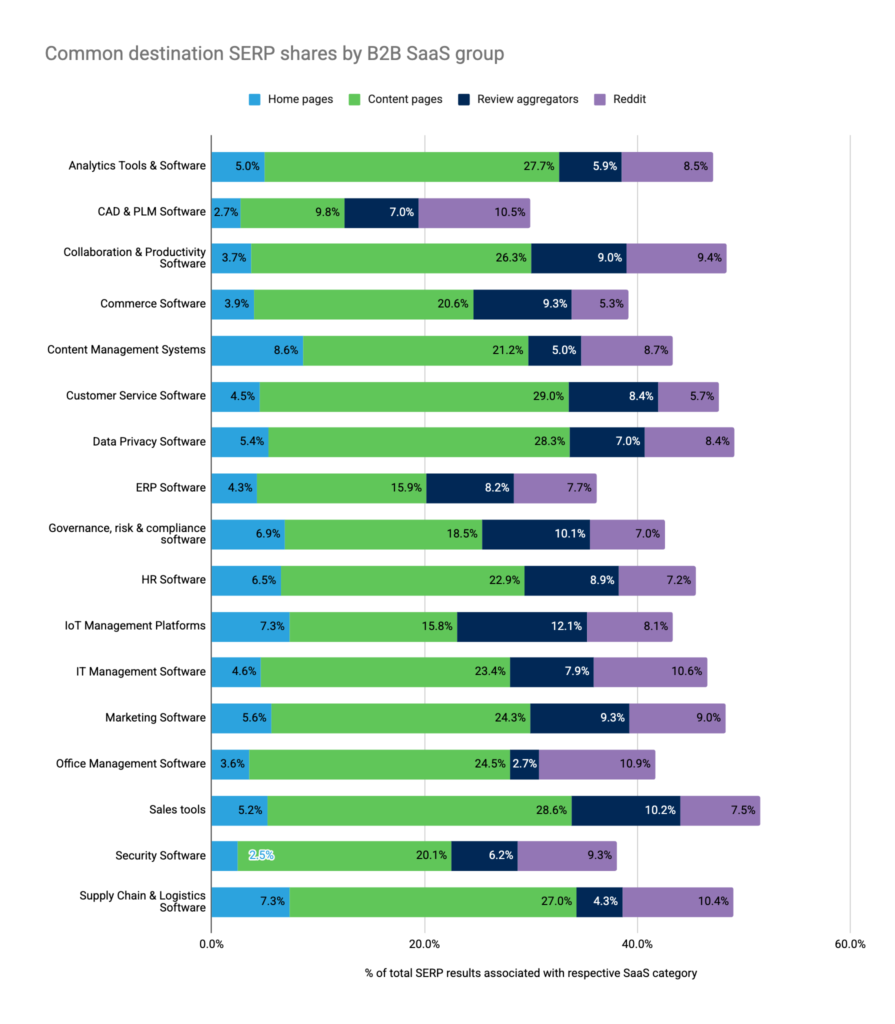
You don’t need me to tell you that Reddit is an SEO powerhouse. Of all the domains in this index, Reddit gets the most Google love: 8.3% of links on the SERP point to Reddit.
However, I wouldn’t say they’re exactly dominating SERPs. About three times as many results point to regular content-type pages (articles, blog posts, etc.). And when you group together review aggregators like Gartner and G2, they account for almost as many results as Reddit.
Home pages (as a group) account for 4.7% of results, followed by links to other Google.com pages at 3.0% and other big tech websites (e.g., IBM, Amazon, etc.) at 1.6%.
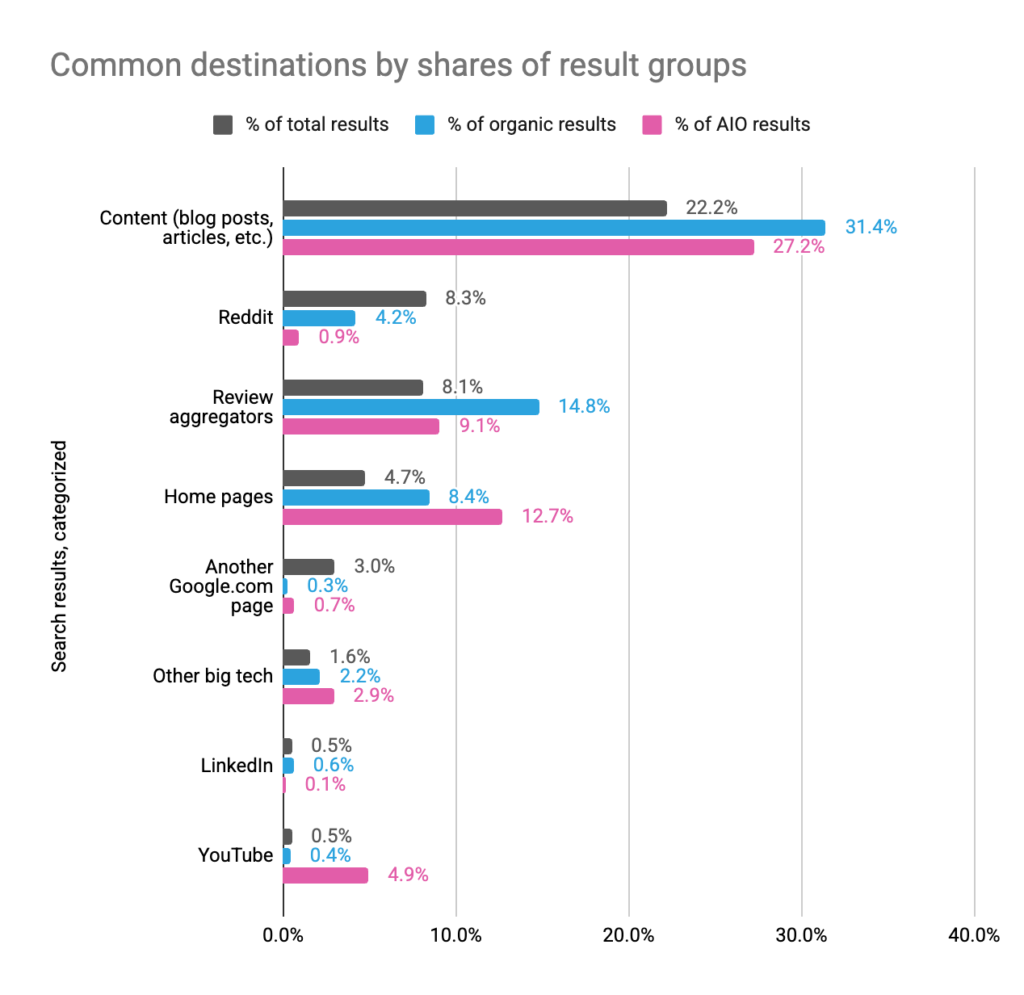
Something I found interesting is that these numbers don’t run parallel when we narrow our focus to shares of organic and AIO results. Reddit may be winning as a domain overall, but the review aggregator and home page groups dwarf Reddit’s share of straight organic links as well as AIO citations.
I’ve broken down the share of total SERP results within those 17 SaaS categories below.
Gartner holds 28.7% of the top organic positions
You read that right.
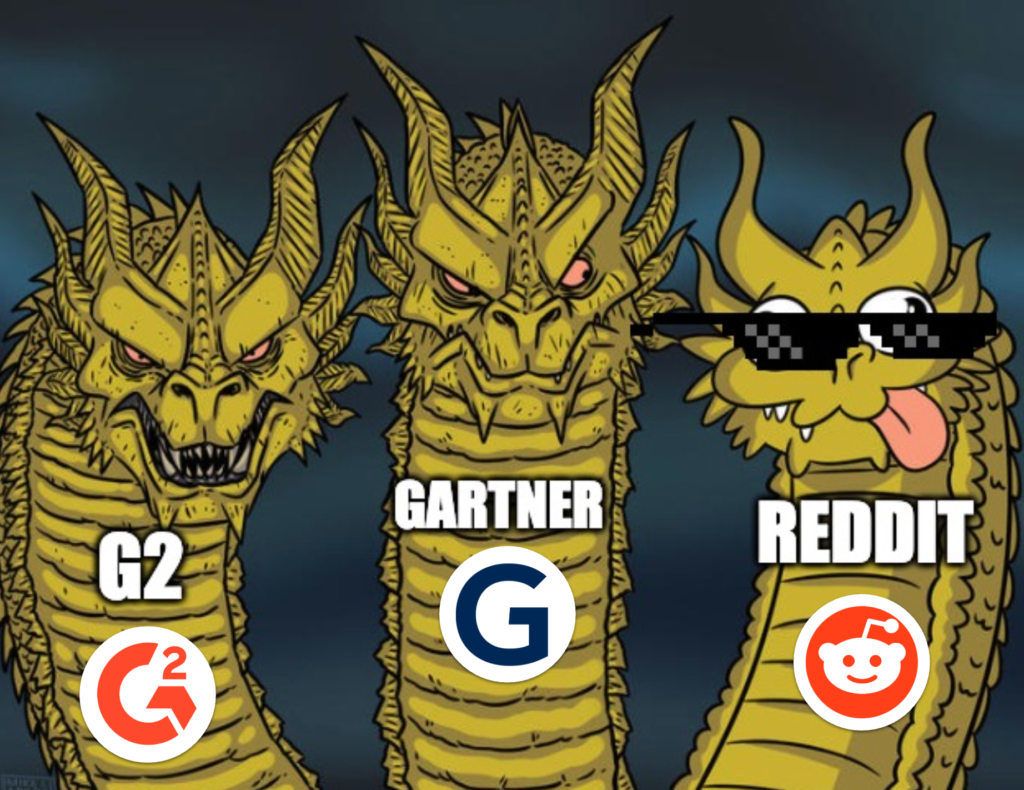
Of all the top organic positions, that is, the ones immediately after the AIOs and the ads, more than a quarter (28.7%) of them belong to Gartner’s massive reviews engine. G2 is a distant second when it comes to top positions held—a slightly less distant second (11.5%) if you lump together results pointing to all the properties they acquired from Gartner earlier this year.
Reddit doesn’t come close to either of them (in terms of both top organics and AIO placements). But they’re still the ones getting all the attention.
Go figure.
G2 is the most-cited source in ChatGPT and Perplexity
We’ve also heard that Reddit is the big dog in LLM citations—but context matters. G2’s citation share outperformed Reddit’s across 1,000 solution-aware prompts on ChatGPT, Perplexity, and Gemini.
When interviewed by CMO Ladder in January, G2’s new CMO Alexandra London said that “software buying is shifting from decisioning to browsing,” and that the “winners will be the sources AI can trust.”
As of last week, G2 is that kind of source.
This report focuses primarily on Google. (After all, that’s where about 74% of desktop search happens.) But we wanted to see how the findings from our search index compared to what we’d get if we tried to find similar answers using other AI platforms.
So we built 1,000 prompts to parallel the intent behind the keywords in our index. These included “simple” prompts like:
“What is the best vulnerability scanner software?”
… as well as what we’d consider more standard for these types of AI tools:
“I’m building a list of potential vulnerability scanner software options for my team. What are the most important factors and capabilities that I should look for as I’m building my shortlist? How would you recommend I go about choosing the ideal option for my team? A few things to keep in mind: I need clear criteria/rationale for this decision, it needs to perform at the enterprise level, and you can ignore price at this point.”
I was planning to type up some rationale for this kind of prompt segmentation, but John-Henry Scherck summed it up very nicely before I got that to that point in writing this:
“Users are loading up LLMs with context. The prompts we track should try and simulate that context, or else it’s just a broad list of what tool has the biggest presence on the web… which isn’t all that useful to track.”
John-Henrey Scherck
Founder, Growth Plays
“Spew-nami!” We’re in the middle of an AI slop storm
Wave after wave of AI-generated and AI-assisted reviews are flooding the SERPs, getting suppressed, and then getting replaced by more.
I ranked the top 20 domains by count of organic results, and threw them into Ahrefs to see how they’ve performed historically. Although there are plenty of established brands in the mix, four of the top 20 domains came out of nowhere with a lot of content … and it doesn’t look human-written:
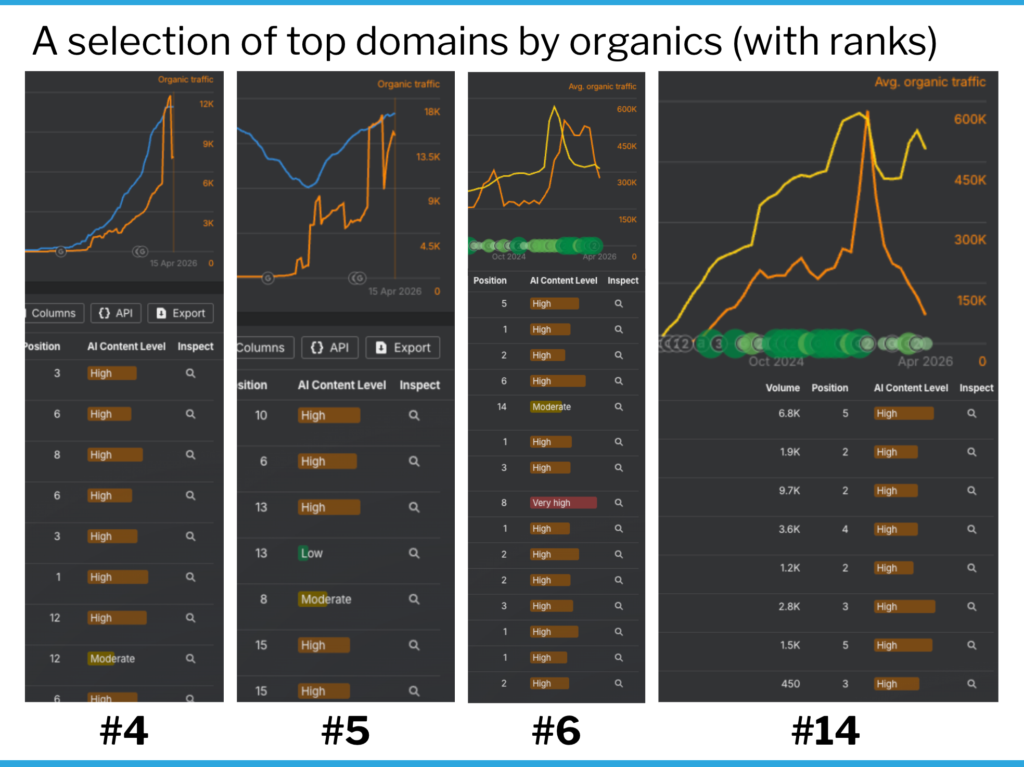
See what I mean by waves?
This tracks with the experiment SE Ranking ran from 2024–2025: A site generates a ton of content, Google gives it a shot in the SERPs, and then throttles the site.
Some of these domains are coming down from “Mount AI.” Others are still at the summit. Others still are on their way up.
Google Search seems to be doing a better job at filtering spam than the other AI platforms we looked at in this report, though. Of the top ten domains by citation share, Ahrefs yields results like this for FIVE of them:
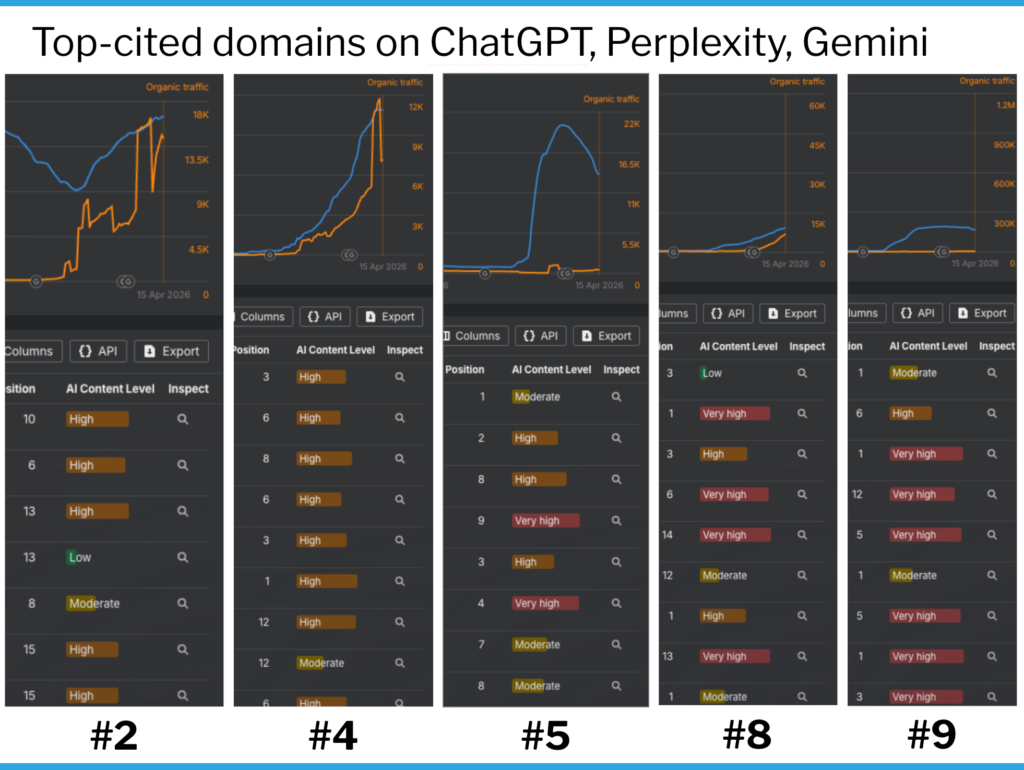
Domains #2 and #4 look familiar? They’re currently #4 and #5 in Google SERPs.
The blue lines on these snapshots represent the number of URLs Ahrefs has indexed on a given domain. And those last three sites are churning it out.
The bots are feeding the bots.
Of course, given LLMs’ bias toward recency, I would not be surprised if April’s top LLM sites show up in May’s SERPs report. (Which, if you want to know when that goes live, give me a follow on LinkedIn!)
All this is to say: I think we’re in for choppy, sloppy waters for a while. Eventually, Google will figure out a way to more effectively suppress these domains systematically. Right now, we get to watch Google play spam whack-a-mole.
Study methodology
OK, let’s talk about where these numbers come from.
- First, Zoe and I scraped G2’s software categories.
- We plugged these product categories into Ahrefs as keywords and looked at the resulting data.
- We clipped those product category keywords based on two criteria:
- It had to be a product category that could reasonably qualify as B2B.
- It had to reasonably qualify as “niche,” which for this report meant it had 150–700 monthly organic searches.
- This left us with 250 niches mapped to 17 high-level B2B SaaS groups:
- Analytics Tools & Software
- CAD & PLM Software
- Collaboration & Productivity Software
- Commerce Software
- Content Management Systems
- Customer Service Software
- Data Privacy Software
- ERP Software
- Governance, risk & compliance software
- HR Software
- IoT Management Platforms
- IT Management Software
- Marketing Software
- Office Management Software
- Sales tools
- Security Software
- Supply Chain & Logistics Software
- We iterated our keywords so that every keyword had the following variants:
- [PRODUCT CATEGORY]
- Best [PRODUCT CATEGORY]
- Enterprise [PRODUCT CATEGORY]
- Best [PRODUCT CATEGORY] for enterprises
- We pulled the top 10 SERP results from every keyword via Ahrefs
- We also iterated a set of 1,000 prompts to feed into ChatGPT, Gemini, and Perplexity via Amadora. These prompts were applied to all 250 software product categories:
- “What is the best [PRODUCT CATEGORY]?”
- “What is the best [PRODUCT CATEGORY] for enterprise teams?”
- “I’m researching [PRODUCT CATEGORY] for my team. What vendors belong on my shortlist?”
- “I’m building a list of potential [PRODUCT CATEGORY] options for my team. What are the most important factors and capabilities I should look for as I build my shortlist? How would you recommend I go about choosing the ideal option for my team? A few things to keep in mind: I need clear criteria/rationale for this decision, it needs to perform at the enterprise level, and you can ignore price at this point.”
- We ran this test for four days: April 7–10, 2026. (Yes, it’s a small sample size—but Amadora was very generous to let us execute 12,000 executions for free—thanks again, Dmitry!)
- And then I began furiously whipping together this report before the data expired lol
What can you do about this?
A few takeaways that every B2B content strategist can start acting on right now:
- Cement your product in its category by giving the LLMs (including Google AIOs) consistency. Make sure your home page, LinkedIn, Crunchbase, and social profiles all accurately and consistently describe not only what your product does, but also what category of product it is.
- Check out your product reviews on Gartner, G2, Capterra, and GetApp. If your domain isn’t showing up in the SERPs right now, your product may still be included in the very first spot. Remember: Gartner, G2, and G2’s subsidiaries currently account for 40.2% of the top organic positions across this index.
- If you want to show up at the very top of SERPs fast, consider publishing a YouTube video that surveys your vertical, explains what problems it solves, and explains how your brand approaches those problems. Almost 5% of AIO links go to YouTube!
- Expect tumultuous rankings for a while. Slop sites are going to proliferate until they stop working, and rankings will likely be in a state of flux as Google sorts this out. Keep creating content that is actually useful for humans and hard to replicate for bots (because it works). And remember: search is huge, but it’s only one part of the awareness and positioning ecosystem.
And of course, if you’d like this kind of thinking applied to your own content strategy, you can always hire Overthink Group. I’m itching to help a new client. 😉