
Every month, Zoe and I analyze a basket of 1,000 B2B SaaS SERPs and 1,000 solution-aware AI prompts across 250 unique, niche product categories. We want to see what happens when enterprise buyers use Google and LLMs to look for solutions.
If you’re a B2B SaaS marketer trying to get on enterprise buyers’ shortlists, we made this report for you. (And if you want more hands-on help, drop me a line!)
Here’s the highlights:
- AIO links are down 69.7% since March (it’s a zero-click world now, baby)
- Search volume is down, AIO saturation is up
- “Discussions” SERP features are up 48.4%
- Reddit, G2, and Gartner are the big dogs in Google
Niche B2B SaaS search stats for May 2026:
Here’s what we found looking at the entire index:
- Google AI Overviews (AIOs) appear on 26.4% of niche B2B SaaS SERPS (up from 21.8% in April).
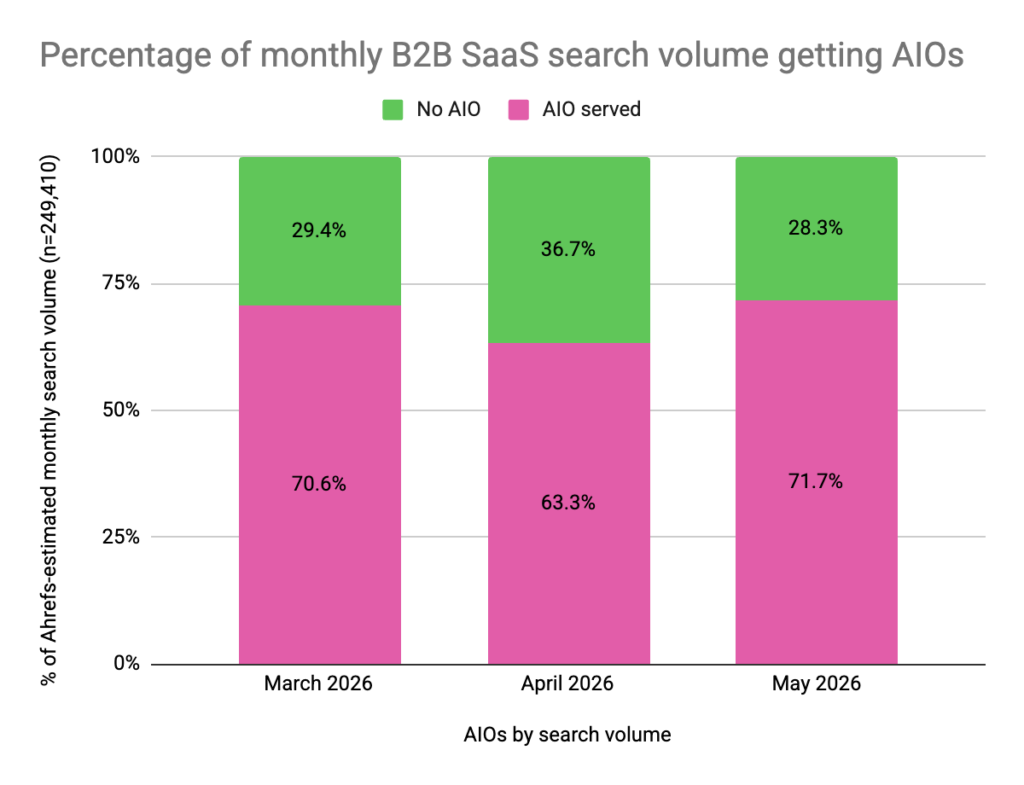
- 71.7% of searches result in AIOs (up from 63.3% in April).
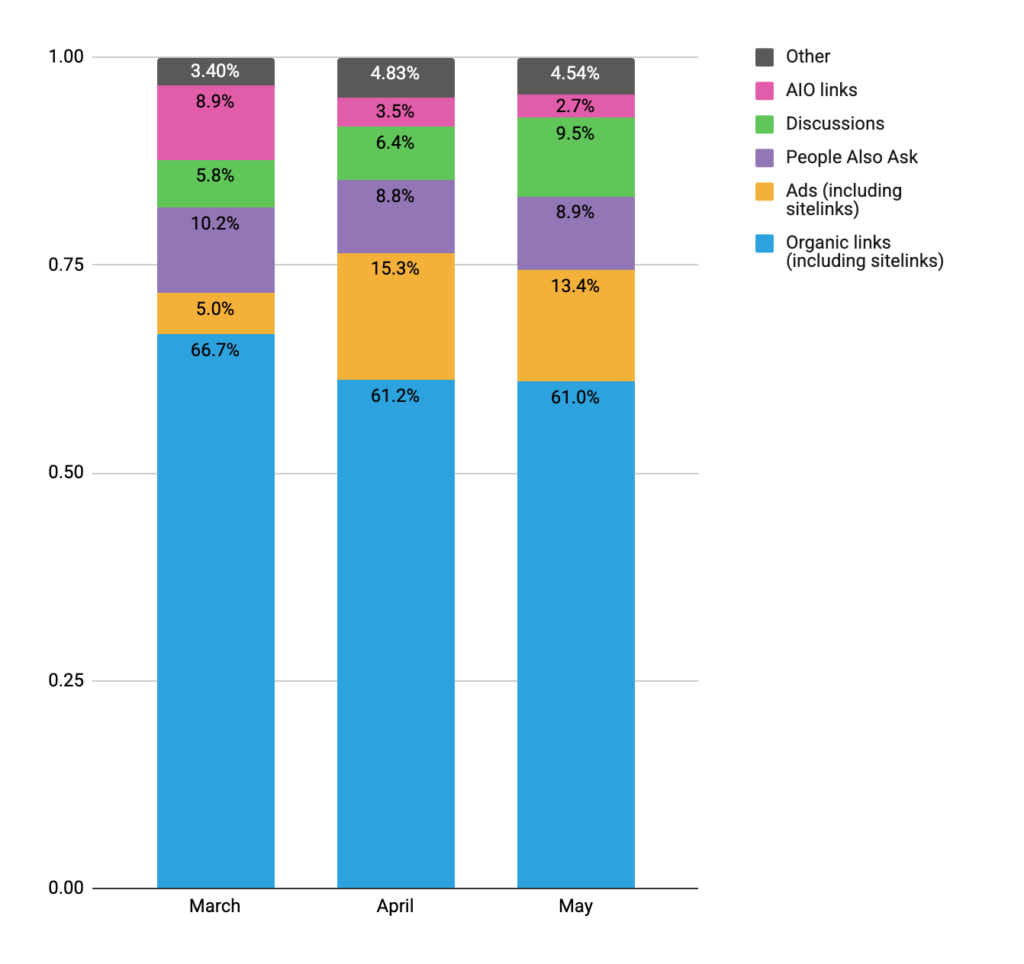
- 13.4% of clickable search results are ads (down from 15.3%).
- 2.7% of total clickable results are in the AIOs (down from 3.6%).
- 12.3% of total results are links to Reddit (a big jump from last month’s 8.3%).
- 61% of total results are organic, if you include organic sitelinks (holding steady from last month).
As far as Google AI Overviews go:
- The average number of links in AIOs has gone down by 69.7% since March.
- 27.8% of results contained in AIOs are content marketing pages (blog posts, articles, etc.).
- 14.6% of results contained in AIOs are pages on review aggregator sites (up from 9.1% in April). Gartner and the G2 network climbed substantially, making up 7.4% and 6.3% of AIO links, respectively.
- 11.3% of results contained in AIOs are brand home pages.
- 8.5% of results contained in AIOs are links to Reddit—a huge jump from just 0.9% in April.
- Only 0.9% of AIO links point to YouTube—a significant dropoff from last month’s 4.9%.
And when it comes to strictly organic results, we saw:
- 31.7% of organic results are content marketing pages (blog posts, articles, etc.).
- 15.7% of organic results are review aggregators (Gartner, G2, etc.).
- 8% of organic results are home pages.
- 5.4% of organic results are links to Reddit.
- Gartner holds 27.4% of all the top organic SERP positions.
But now let’s look at some of the more interesting things we found, and what they mean for B2B SaaS marketers.
AIO links are down 69.7% since March
It’s a zero-click world now, baby.
When we ran our first report in March, the average Google AI Overview included 7.8 links. These included citations, thumbnails, videos—all that clickable stuff. Today, they include about two.
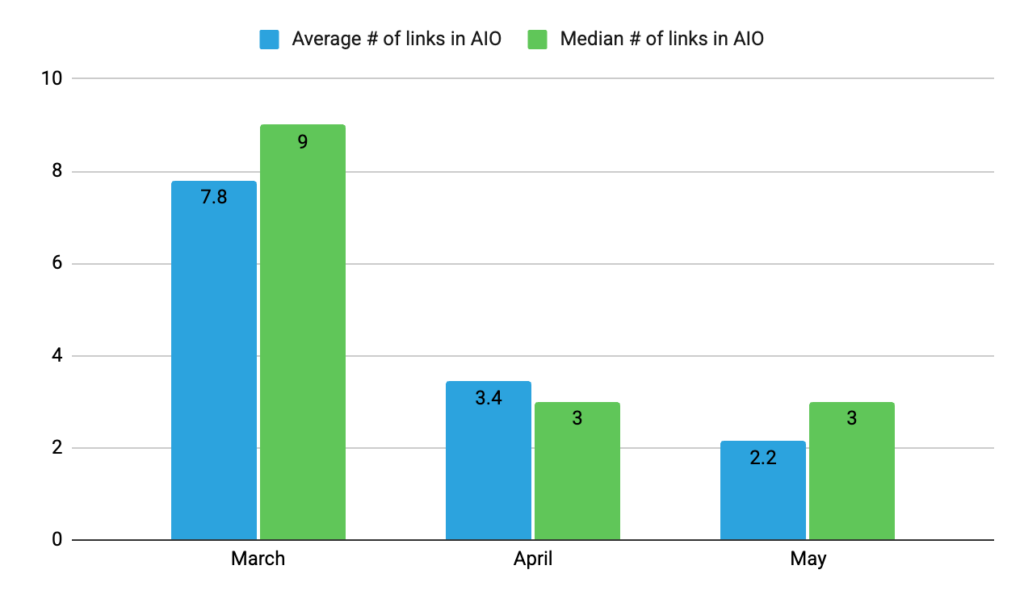
These AIOs are listing solution candidates without linking to their pages. They’re summarizing Reddit threads, G2 reviews, and listicle rankings. They’re giving people plenty to read, and they’re not sending people to as many sources.
And this is the case for most searches in this index. There is some correlation between monthly search volume and number of links included in the AIO (correlation coefficient of 0.37).
What this means for marketers: Even Google is behaving like an LLM. If you want to get found when buyers start building their shortlists, you can’t rely on AIO citations. You need to get your tool mentioned in these overviews.
Search volume is down, AIO density is up
Across all 1,000 keywords, search volume is down 56%. This might be due to the fiscal year being finished—the race to spend last year’s technology budget is over.
However, the percentage of searches getting served AIOs is on the rise.
About a quarter of the SERPs in our index sport Google AI Overviews. That’s about a 21% increase in AIO saturation since the dip in April’s report.
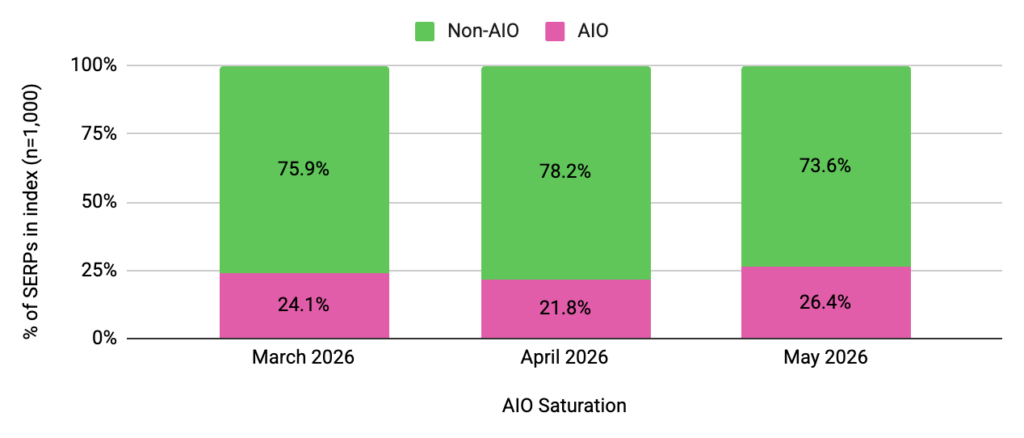
But we also need to know how often these AIOs are getting served. In general, Google puts these on SERPs for higher-volume keywords: across the index, with 71.7% of searches resulting in an AIO.
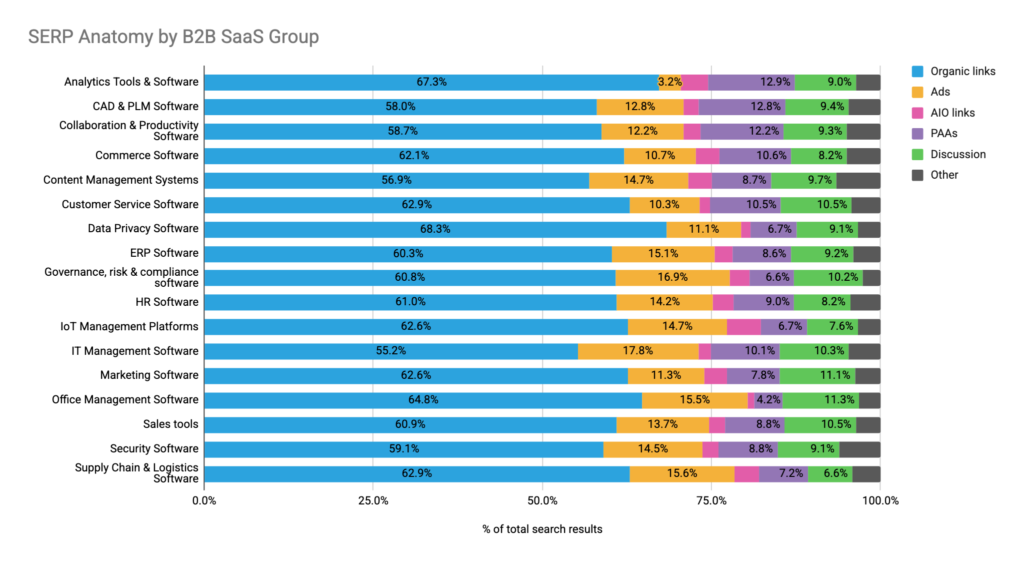
Here’s how that breaks down across the 17 niche B2B SaaS groups:
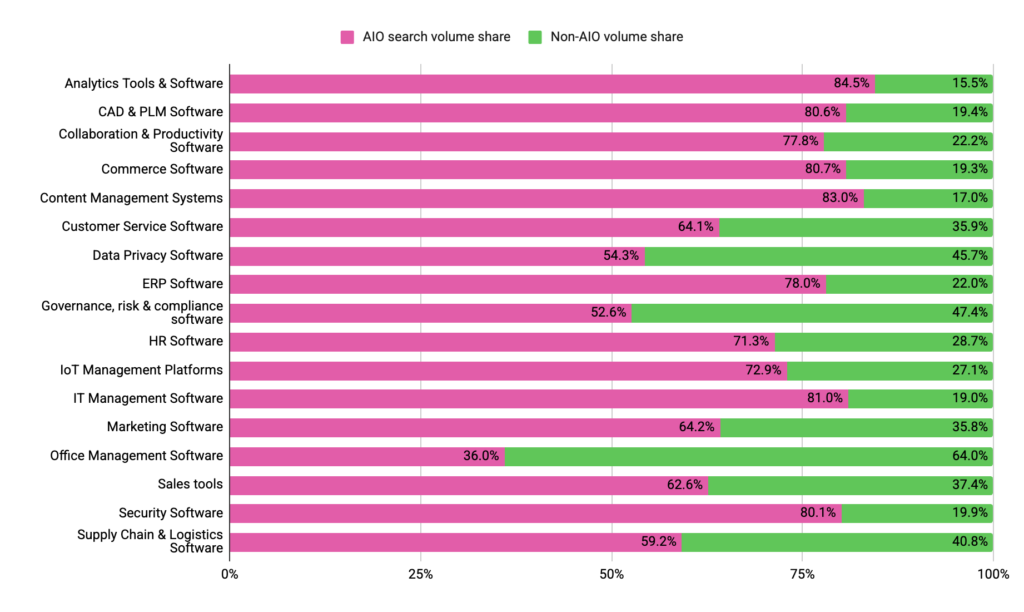
What this means for marketers: AIOs are (almost) everywhere. They’re the first thing most buyers will see when they’re looking for solutions, and you need to make sure you’re showing up in them.
“Discussions” SERP features are up 48.4%
For many of these searches, Google clips various forum threads right onto the SERP. These come from many sites, but for the last three months, over 85% of the links in Discussions SERP features point to one of three sites: Reddit (duh), Quora, and G2.
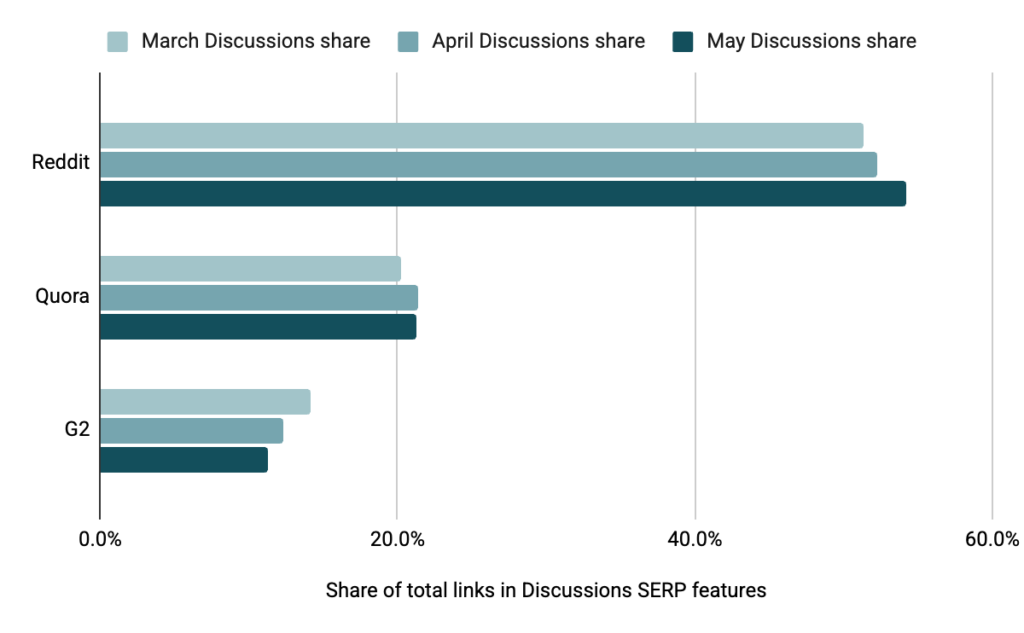
The anatomy of solution-aware SERPs is shifting. While we saw a huge leap in ads present from March to April, now we’re seeing a significant jump in user-generated content. Across the index, Discussions account for 9.5% of total search results.
This consistently applies to the individual solution categories, too. While there’s still a good deal of variance in ad saturation, Discussions pretty consistently occupy about 9–11% of the results in most categories. (And the outliers don’t fall too far outside that range.)
What this means for marketers: Google’s slapping more of this “real” input from people who have used your products and your competitors’ products on their SERPs. I use scare quotes because many of these threads are actually AI-generated conversation starters with no actual human discussions happening. If you want to increase your brand visibility, participating in these discussions (or having dedicated fans talking about you) is a pretty low-effort way to do so today.
Reddit, G2, and Gartner are the big dogs in Google
By now, we’ve all heard how powerful Reddit is when it comes to search visibility. This month, we saw a surge in Reddit links in SERPs. In May, 11.3% of all search results in this index are links to Reddit—that’s a hike up from last month’s 8.3%.
But Reddit isn’t the only powerhouse gaining momentum. G2’s network (which includes their flagship site as well as Capterra, Software Advice, and GetApp) has gone from owning 4.6% of the total results to 7.3%. Gartner has grown as well, going from 3.1% of total results to 4.0%.
If we look at their placements in AIOs and top organic links, we start to see just how dominant G2 and Gartner really are. Both of these massive platforms have a greater share of organic links than Reddit, and when it comes to the top organic position (after the AIOs), Gartner still controls more than a quarter of those slots.
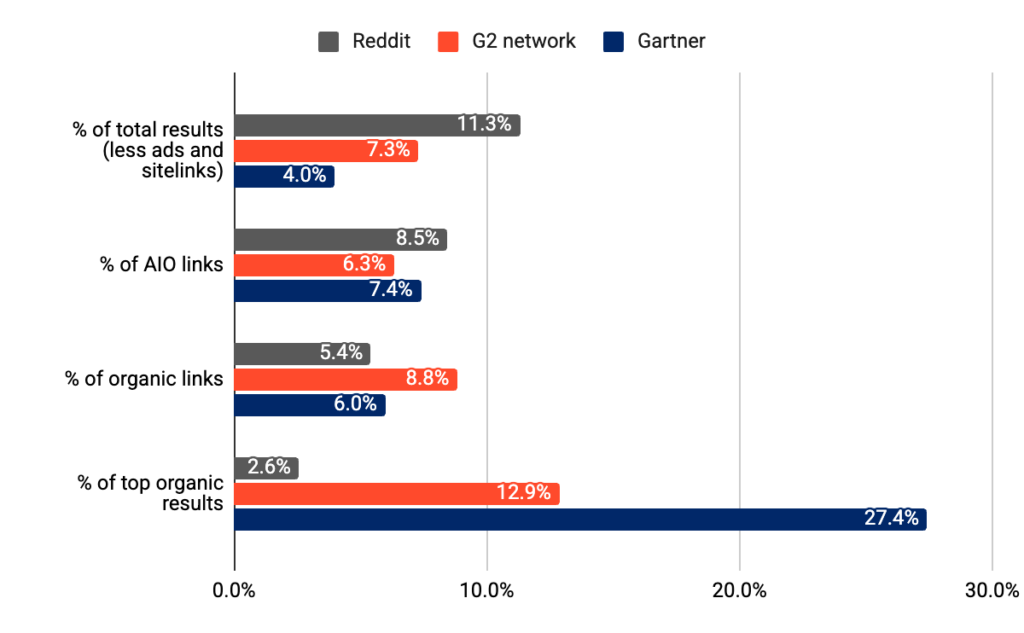
If we compare this to last month’s report, we see that all three of these players have expanded their shares of AIO links—especially Reddit, who grew from a tiny 0.9% share to leading the pack at 8.5%.
Furthermore, while Gartner’s hold on top organic positions remains impressive, G2 is rapidly gaining ground. Last month they held 9.8% of the top positions, but they’ve gained another three percentage points since.
What this means for marketers: We need to start thinking of Gartner and G2 as more than platforms for generating trust marks. They’re visibility platforms now, and there’s a very good chance that buyers will see your product on these sites before they ever hit your own domain.
About the Niche B2B SaaS SERP Index
For a while now, marketing leaders have been under pressure to figure out how they’re going to handle search in the age of AI. If you’ve felt like that conversation is pulling you in ninety-six directions at once, I feel you.
Most of the SEO community is talking about AI search and visibility at the general level.
That’s kind of like reading about your hometown’s climate on Wikipedia—it gives you the big picture, but it doesn’t tell you if you need to bring an umbrella to work today.
What matters more than the large-scale changes in search is the SERPs in our own product category verticals right now.
So Overthink Group General Manager Zoe Tjoelker and I created our own niche B2B SaaS SERP index. This is a basket of 1,000 SERPs for solution-aware keywords related to 250 niche software product categories from G2’s database. We’re looking specifically at what people see when they Google low-volume, solution-aware keywords.
Think of this as the local SEO weather report for B2B SaaS.
Study methodology
OK, let’s talk about where these numbers come from.
- First, Zoe and I scraped G2’s software categories.
- We plugged these product categories into Ahrefs as keywords and looked at the resulting data.
- We clipped those product category keywords based on two criteria:
- It had to be a product category that could reasonably qualify as B2B.
- It had to reasonably qualify as “niche,” which for this report meant it had 150–700 monthly organic searches.
- This left us with 250 niches mapped to 17 high-level B2B SaaS groups:
- Analytics Tools & Software
- CAD & PLM Software
- Collaboration & Productivity Software
- Commerce Software
- Content Management Systems
- Customer Service Software
- Data Privacy Software
- ERP Software
- Governance, risk & compliance software
- HR Software
- IoT Management Platforms
- IT Management Software
- Marketing Software
- Office Management Software
- Sales tools
- Security Software
- Supply Chain & Logistics Software
- We iterated our keywords so that every keyword had the following variants:
- [PRODUCT CATEGORY]
- Best [PRODUCT CATEGORY]
- Enterprise [PRODUCT CATEGORY]
- Best [PRODUCT CATEGORY] for enterprises
- We pulled the top 10 SERP results from every keyword via Ahrefs
- We also iterated a set of 1,000 prompts to feed into ChatGPT, Gemini, and Perplexity via Amadora. These prompts were applied to all 250 software product categories:
- “What is the best [PRODUCT CATEGORY]?”
- “What is the best [PRODUCT CATEGORY] for enterprise teams?”
- “I’m researching [PRODUCT CATEGORY] for my team. What vendors belong on my shortlist?”
- “I’m building a list of potential [PRODUCT CATEGORY] options for my team. What are the most important factors and capabilities I should look for as I build my shortlist? How would you recommend I go about choosing the ideal option for my team? A few things to keep in mind: I need clear criteria/rationale for this decision, it needs to perform at the enterprise level, and you can ignore price at this point.”
- We ran this test for four days: April 7–10, 2026. (Yes, it’s a small sample size—but Amadora was very generous to let us execute 12,000 executions for free—thanks again, Dmitry!)
- And then I began furiously whipping together this report before the data expired lol