
“We need to be in the top 3 options for our product category from the start.”
That’s what the client told us they wanted in 2025.
They weren’t completely unknown in their space. But as far as Google was concerned, they weren’t in the top 3 solutions for their product category, either.
Now they’re at the top of the SERPs and Google’s AI Overviews are plugging them as the lead contender.
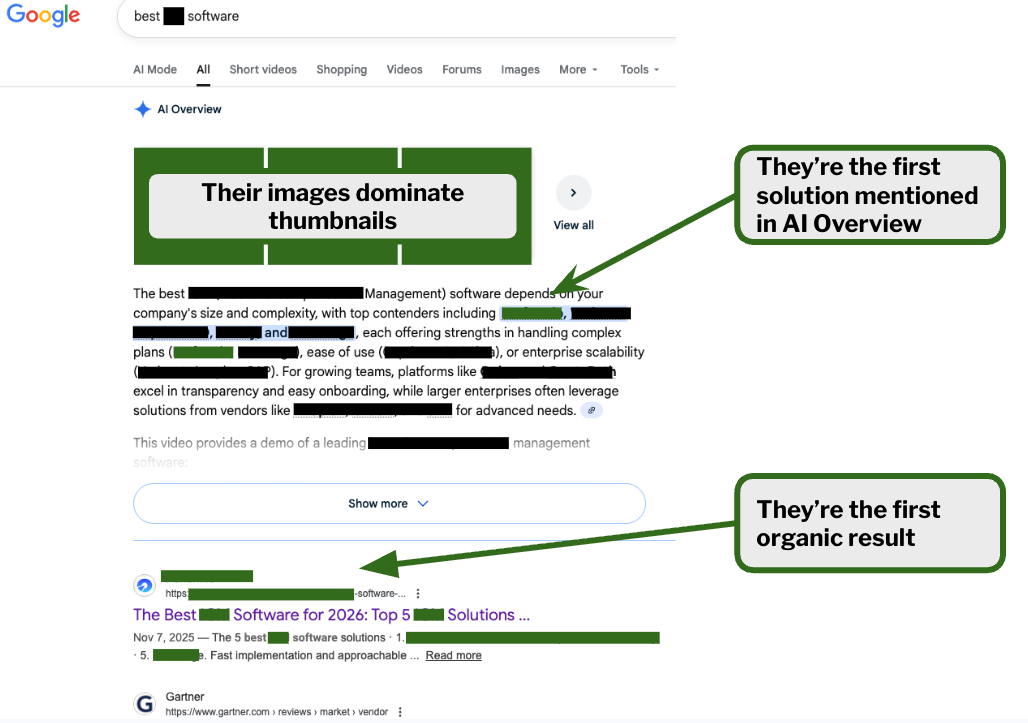
Today, if you Google the “best software” in their category, they not only rank #1 in organic results, but they’re consistently in the first three solutions mentioned in Google’s AI Overviews … and often, they’re mentioned first:
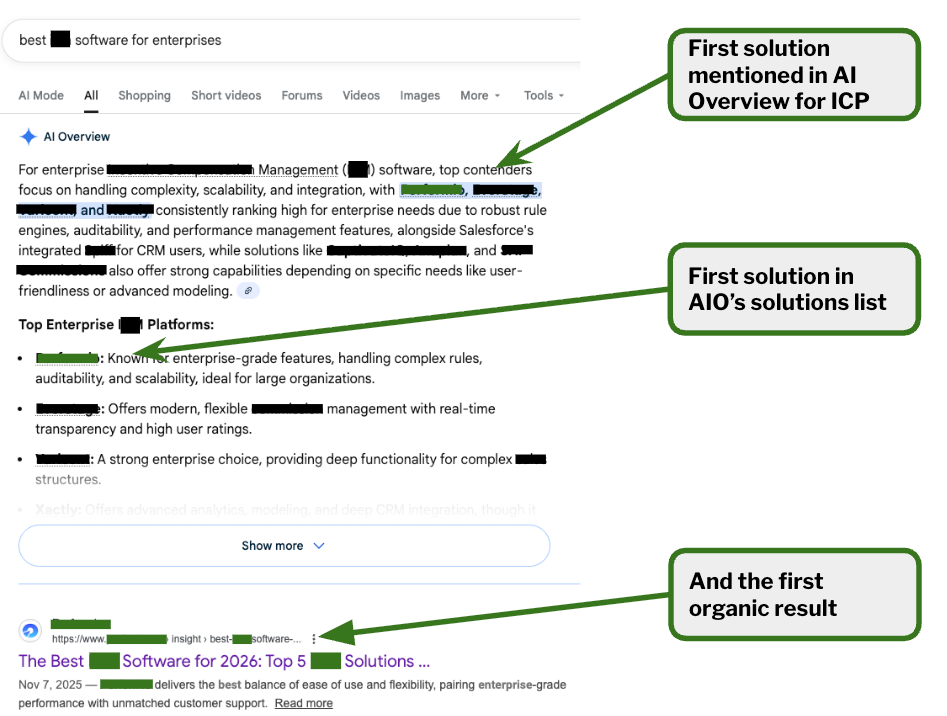
Not only that, but they rank #1 when people specifically Google enterprise solutions in their product category, with early (or first) billing in the corresponding AIOs we’ve observed:
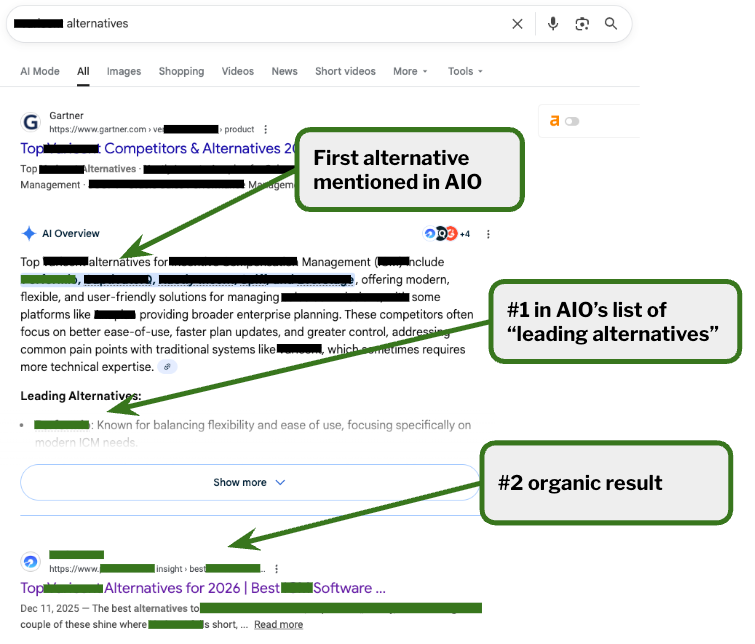
… and they’re in both the top organic results and (often) the AIOs when people search for alternatives to their main competitor:
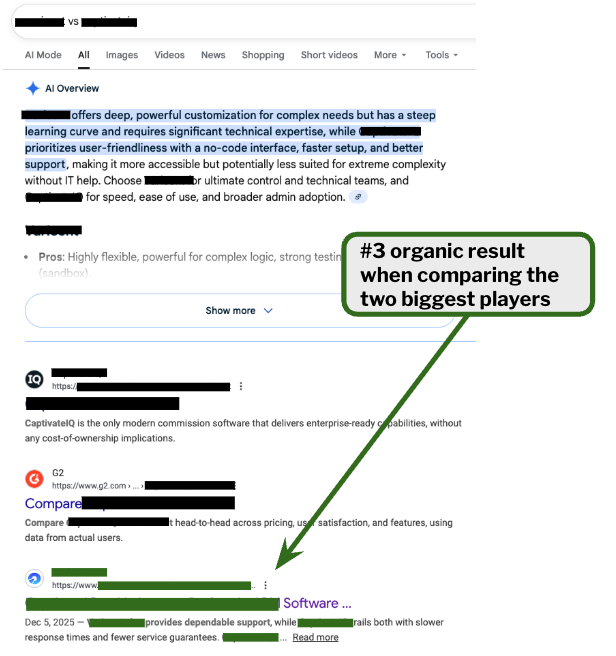
… AND they even commonly pop up when people compare their two most popular competitors:
Of course, I should mention up front: no two AIOs are alike. Normally if you run the same query through Google AI twice, you get different text introducing a different list of brands in different orders.
However, this client, like most of the B2B SaaS companies we’ve worked with, is in a rather well-defined product category with maybe two dozen competitors if we’re being generous. That means AIOs describing players in this space are more consistent in the brands they mention than they are with broader topics. I’ve been testing this for two weeks now, and the screenshots I’ve shared are reflective of what I keep seeing.
Wouldn’t it be great to show your CMO screenshots like this for your product category?
Here’s how we did it.
The 4 SEO pages driving these results
The screenshots above are all due to only four blog posts we wrote for the client. None of these post concepts are revolutionary:
- A buyer’s guide for choosing a solution
- A “best-of” listicle of product options
- A side-by-side product comparison piece
- A listicle of alternatives to the main competitor
Nothing especially new or exciting here, at least not on the surface. In fact, several of our competitors have published this same type of content. So, why are these articles outperforming the rest?
The BOSS Method: Biased, Objective Scoring Systems
Our approach to these articles was specifically optimized for both traditional search and LLMs. It’s tough to pull off—but that also makes it tough to imitate.
We call it the BOSS method.
BOSS = Biased, Objective Scoring Systems
The BOSS method is the process of evaluating you and your competitors based on the most important decision criteria your target audience needs to consider, then publishing the findings from that analysis in formats that Google and LLMs love.
“Wait. Biased AND objective?”
Yes. And it involves three major phases:
- Create a rubric for evaluating options based on what you believe should be the most important factors. (That’s the biased part.)
- Grade yourself and your competitors fairly based on that rubric. (That’s the objective part.)
- Publish a comprehensive suite of authoritative content on your category using the scores you get from phases 1 and 2.
This is the kind of analysis that people normally only get from third-party consultants—think Gartner’s Magic Quadrant or the Forrester Wave reports. If you pull it off right, your buyer’s guides, comparison pages, and the like will be dripping with highly relevant, authoritative content that satisfies traditional search intent at the solution- and product awareness stages, so Google can’t help but rank it.
Plus, the BOSS method sets you up to produce content that LLMs can easily ingest and cite. These SEO pages naturally position your brand near category-specific vocabulary and feed into the kinds of AI Overviews Google puts at the top of category-level searches. Better yet, they give AI platforms plenty of canonical examples of your offering’s differentiating strengths … and your competitors’ weaknesses.
BOSS content is grounded in real customer decision factors
If you’re presenting this kind of content to the market, it better be grounded in something more than just hearsay. Anyone can say they’re the best, and anyone can assign scores—but for those scores to mean something, they need to come from somewhere.
We worked with our client to make a rubric informed by how real customers were making purchase decisions as well as the client’s perspectives on the product category as a whole, taking several things into account:
- We ran a survey asking ICPs what they considered most important when choosing a solution.
- We scoured third-party analyst reports and review aggregators to see what they deemed important.
- We interviewed the client’s sales leadership to learn what people in the pipeline said was most important.
- We interviewed the client’s executive leadership to get their take on product strategy within the category, and their broad vision for product positioning.
These inputs informed both the factors we graded the market on and the weights that each factor contributed to the final score.
Then we worked with SMEs from product marketing, consultative sales, and the executive leadership team to build objective grading scales for each identified factor.
In the end, we built a rubric that graded products on 10 decision factors based on 50 individual grading vectors.
This is a rigorous process. It forces you to clarify how you believe people should actually be thinking about your product category. It pushes you beyond the obvious, answering questions like:
- What do we really mean by “ease of use”?
- What makes one platform more “scalable” than another?
- What is our standard for acceptable “analytics and reporting”?
But once it’s done, you and your competitors will each have scores on the key decision factors you choose, plus a final total score. You can see how you and the other players stack up based on how you believe people should think about the category.
That’s where things get interesting.
Because once you have a scoring system, you can slice and dice those scores to create content that materially informs your audience. You’re not just listing qualitative pros and cons: you’re quantitatively stacking up the product category on your own terms.
Here’s how the BOSS method made each of those four blog posts something more than just another generic SEO grab.
1. The BOSS buyer’s guide lists key decision factors, and scores all the players
If you scan the article’s table of contents, you won’t find anything out of the ordinary. The buyer’s guide covers the basics: why this decision matters, how to design a selection process, how to write an RFP, etc.
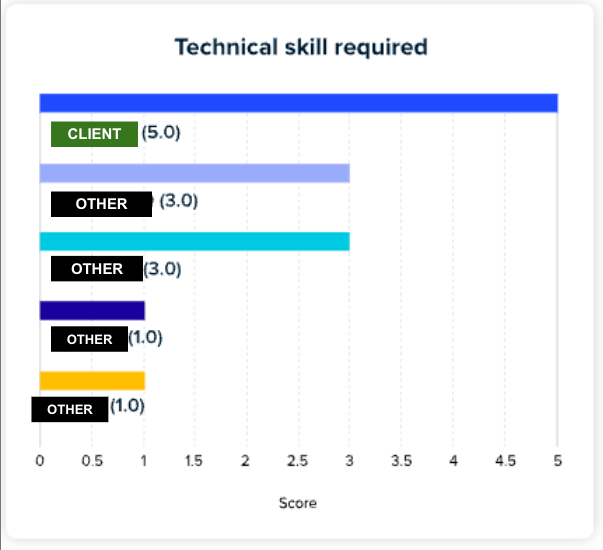
But then you get to a list of 10 decision factors to consider when making your choice. For each factor, you can get a side-by-side comparison of how the client and other contenders perform in that area.
For some of these factors, the client’s product gets full marks:
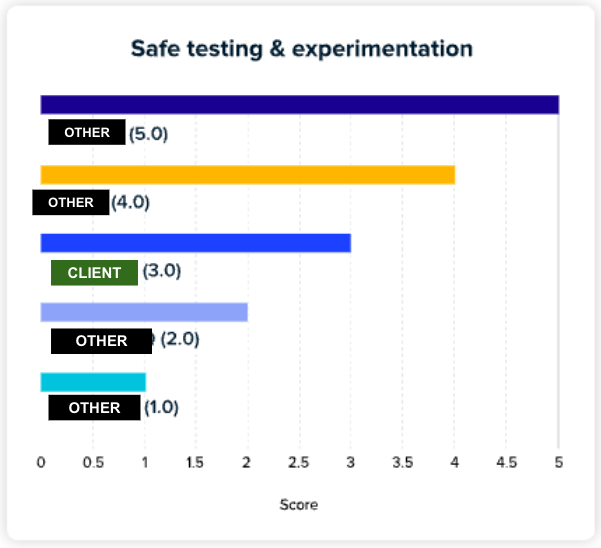
But they don’t get the top score in every single factor:
Beyond this, the article includes a full description of the scoring methodology for every single factor, so people can see exactly what a given score means:

“Wouldn’t that make it hard for people to scan the article, Jeffrey?”
Yeah, probably. That’s why we put all the technical scoring methodology stuff at the very end of the article as an appendix. We figured maybe 2% of the people reading this article would actually want to dig into the nitty-gritty of our scoring methodology.
But you know who DOESN’T give up on an article just because it’s already gone on for 5,000 words? Google, ChatGPT, Perplexity—the machines that decide how relevant the article is to searches concerning what the “best” software in this category is. And you know what helps establish EEAT and exceed quality guidelines: clear, evident rationale.
2. The BOSS “best-of” listicle gives rankings with actual rationale
On its surface, this one’s an even less novel concept. It’s a simple list of the most popular options in the space, ranked from best to … least best. Most of our client’s competitors have blog posts like this. You can probably say the same for your own competitors too.
But in a BOSS best-of listicle, all the software options are ranked based on a weighted function of their scores in the rubric you design. For our client, this meant weighting those ten factor subscores described in the buyer’s guide:
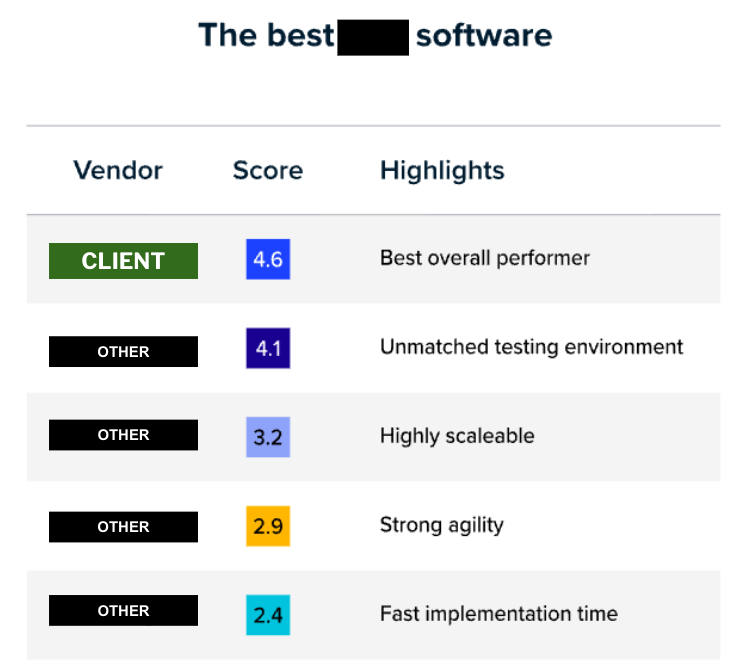
Then the list unpacks how each player performs on those topics, this time comparing each factor subscore to the average before listing out the pros and cons:

Of course, the article links to the buyer’s guide, in case anyone wants a better understanding of those decision factors or the way every product was graded on them.
3. BOSS product comparison pages offer more than just a table
A regular comparison page gives readers a simple look at options side-by-side—and the table tends to amount to “Are they us? Nope. Go us!”
But with the BOSS method, you get to compare competitors against both yourself and the ideals you want your audience to have in mind for your category. Because you’ve articulated the important decision factors, you can explain how each competitor performs in these specific areas.
At least, that’s what worked for our client.
It’s a far more valuable (and believable) way to talk about competitors to your audience, even though they know you’re biased. And if you hold yourself to a high standard of objectivity, your comparison pages don’t come off as petty shots across the bow.
4. BOSS alternatives pages objectively address active concerns
Most people Googling alternatives to your competitors fall into one of two groups:
- Dissatisfied customers who want to switch
- Active shoppers building out a shortlist
Both groups are looking for better options. By listing out those options using decision factors based on survey responses from actual professionals in the market, we could address the real concerns that the market has when considering each competitor.
Why the BOSS method works for organic results and AIOs
If you want to do what our client did (and really, what B2B SaaS company doesn’t want to do that?), you need to give Google two things:
- A reason to serve up your content in organic links when people search for product-category terms
- A reason to mention your product as one of the “best” in your category when it’s generating AI Overviews
In our experience, the BOSS method satisfies Google on both fronts. The screenshots I shared at the beginning of this article are the results of four blog posts—but that’s not the full extent of the content we’ve created from this one rubric. There are other comparison pages and alternatives lists on the way.
The BOSS method gives you lots of highly relevant, authoritative content on your product category. It’s content that’s easy for Google to rank, easy for LLMs to cite, and very difficult for anyone else to imitate.
Here’s why the BOSS method is an effective B2B SEO strategy.
1. The BOSS method covers your product category comprehensively
When you build a strong scoring system, you have everything you need to answer all the big questions people are asking about your product category. This means when people Google categorical terms, you’ve given Google an exhaustive set of content to pull from, whether it’s in organic rankings or in AIOs.
One rubric becomes the foundation of dozens of pieces. This case study describes the basic installments (a buyer’s guide, a best-of roundup, comparison pages, and lists of competitor alternatives), but that’s only the beginning.
Many product categories have established subcategories. For example, the category of “SEO tools” includes these subcategories:
- Keyword research tools
- Backlink analysis tools
- On-page optimization tools
- Technical SEO auditing tools
- Content analysis tools
If someone has a rigorous rubric of what makes a great SEO tool, they can pare down those BOSS scores into five smaller subrubrics, one for each of these subcategories. That means five more buyer’s guides, five more best-of lists, and five more segments to append to comparison and alternative pages. These new content suites give you the opportunity to position your product in adjacent (or sub-) categories, and the BOSS method gives you the credibility to do so in a way that satisfies both humans and machines
Plus, each BOSS decision factor can be the star of its own dedicated blog post, webinar, and/or YouTube video—which gives you yet another opportunity to address the capabilities and concerns real people in your market care about.
A single BOSS rubric takes a lot of time and effort to make, but it sets you up to create a staggeringly comprehensive suite of highly relevant content on your product category.
2. The BOSS method keeps your product category content consistent
By establishing a core set of scores, you protect yourself from inconsistently addressing a given decision factor or competitor across your library. Everything ties back to the rubric, which means you consistently find ways to repeat your own selling points in different relevant contexts.
This is very useful when it comes to getting LLMs to present your talking points to users. If you follow the BOSS method, you have the potential to create dozens of pages that explain why your offering is the best option when it comes to, say, scalability or ease of use. Because your writers are always citing the same source (the BOSS), these pages will naturally stay consistent in their arguments.
3. The BOSS method gives you a reason to call yourself the best
It’s easy to say you’re the best in your category. It’s a lot more difficult to convincingly explain why.
The BOSS method addresses this problem directly. Your writers, sales folks, event speakers, and execs can point to the scores you’ve published and say, “This is why we’re the best,” or better yet, “Here’s why we’re the best in the areas that really matter.” Once that argument has been made, you can beat that drum over and over again.
But how does this help you in terms of Google SERPs?
First, it gives you at least one (but ideally several) pages on your site that rank your offerings as the best in your category. That means that Google has at least one example of someone listing you as option #1, even if that someone is you.
That’s a lot better than nothing—and sometimes it’s all you need to convince Google. For example, before we used the BOSS method, the client in this case study didn’t hold the #1 position on any major ranking lists within the category. Now Google’s AI Overviews often give them first billing in their lists of options.
Second, it feeds those LLMs plenty of specific lines about why you’re the best—lines that might not exist anywhere else. These AI tools try to predict believable responses to prompts (“spicy autocomplete,” as Rand Fishkin puts it). By publishing BOSS content, you’re feeding LLMs reasons to plausibly mention your brand when answering questions about your product category.
4. The BOSS method is prohibitively difficult to imitate
Developing a biased yet objective scoring system is not easy work. It takes time and effort to determine which decision factors you’re going to grade yourself and competitors on. It’s even more demanding to develop the grading scales you’ll use to generate scores within those factors. And then of course there’s the task of fairly applying those grades to category players.
It requires lots of familiarity with the audience, with the products in the category, and with setting up scoring systems.
It can take weeks. You might have to spend some internal social capital to get the input you need. And you might have to skip a karaoke night so you can figure out just how to come up with a fair grading system for quality of customer support. (I sure hope whoever sang “Piano Man” instead of me that night did OK.)
So it’s no surprise that most brands don’t do it. Instead they publish the simple buyers’ guides and listicles you’re used to seeing in the SERPs—the kind of stuff that can be easily written by just rewriting the stuff that’s already out there.
“Couldn’t ChatGPT do this?”
Oh, sure. ChatGPT would be totally happy to make a rubric and grade everyone on it.
And if you ran the exact same prompt a second time, you’d get something different—how trustworthy is that?! (Seriously: I gave ChatGPT a good-faith try. It gave me “CFO-ready” breakdowns that would have made me the joke of Zoom calls for the next three fiscal quarters.)
Generative AI is a starting point for the BOSS method at best. Outsourcing your rubric to ChatGPT or any other LLM still leaves you solving the hardest problems yourself:
- Fact-checking. A quick glance at the ChatGPT’s rubric reveals obvious factual mistakes—and those are just the ones I know about. I would need to pick through all the cited sources and hope that the bot’s confidence is founded.
- Deciphering scores. LLMs are sophisticated guessing machines. They generate text and numbers that they predict would likely satisfy prompts. This means it’s still on me to figure out whether or not some of these players deserve the scores ChatGPT gave them. A simple scan of ChatGPT’s interpretation of “implementation” shows me this is going to be a pain.
- Justifying scores. It’s not just the work that makes BOSS tough to pull off. There’s also the sense of risk. If you go on record giving your competitor a score of “2” and yourself a score of “5,” you need to be ready to justify that score. And LLMs have no idea why they say what they say. Which means when it comes to making actual sense of scores, you’re on your own.
- Strategic product positioning. AI can create a rubric that gives you the highest score (or any score you want). But unless you articulate the decision factors your brand actually believes matter, you’re working with a rubric based on (at best) generic findings from around the internet. Your people know more about why you built your product the way you did than LLMs—why not put that expertise to work for you?
Bottom line: BOSS can’t be replicated by LLMs right now. If anyone uses AI for this, they’ll get biased scores, but no objective system. That’s not BOSS. That’s just BS.
The BOSS method requires some audacity. It’s the kind of audacity that your competitors probably don’t have, and the kind of audacity that Google currently rewards.
Overthink Group does B2B SEO like this
We developed the very beginnings of the BOSS method back in 2023, and we’ve been refining it over the years. It’s been super reliable for us, even as AIOs started crowding in on product category SERPs.
In my opinion, it’s one of the most valuable kinds of projects we do for our clients.You can use the BOSS method on your own—but if you’re a B2B SaaS company who would prefer to have an experienced team working on this, I’d sure love to chat with you about it.