
In June, Overthink Group partnered with Amadora to analyze 1,263 solution-aware prompts across four popular AI search channels: ChatGPT, Gemini, Perplexity, and Google AI Overviews. We ran each of these prompts for one business week.
Last quarter, G2’s research indicated that 51% of software buyers are more likely to begin their research process with an AI tool than a Google search. We wanted to know what kind of content these platforms cite when helping those buyers build their shortlists (and we also wanted to see how Google’s AIOs compared).
Most of our clients promote specialized tools to specific audiences. So this study focused on niche B2B software categories. And by “niche,” I mean the average monthly Google search volume for these software categories is about 350. We’re looking at what happens when people search for things like “XDR platforms” and “payroll tax compliance software.”
It should go without saying, but all the figures in this report refer to our experiment. These numbers aren’t indicative of all AI results—but they do give you an idea of what people see when they ask these tools things like, “I’m researching [niche software] options for my enterprise team. What tools should I consider for my shortlist?”
(If you want to know more about the prompts we used, check out our methodology at the end of this article!)
The big takeaways:
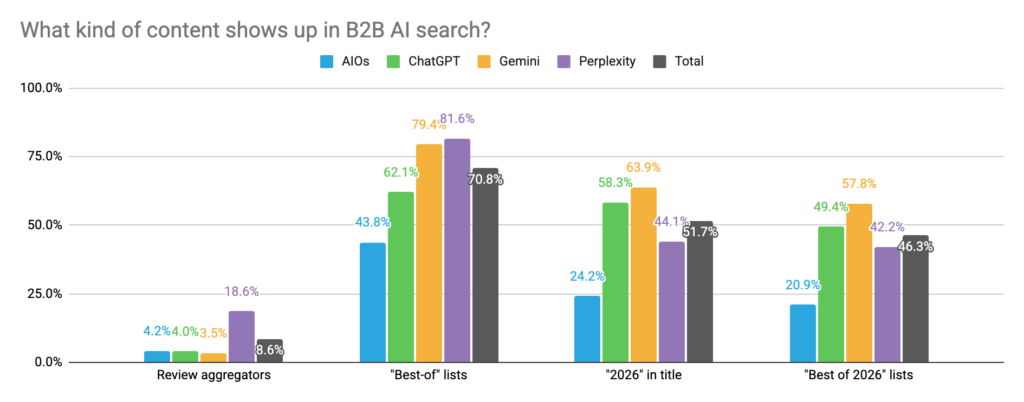
- LLMs still love “best of this year” listicles. 70.8% of all citations are a lineup of “best” or “top” options. And 51.6% of all citations include “2026” in the title.
- ChatGPT and Perplexity love spam. 14.5% of ChatGPT citations and 11.3% of Perplexity citations point to synthetic sites featuring thousands of articles written by bots for bots. These spam sites account for 8.6% of the total citations detected by this experiment.
- G2 is the breakaway leader in citations across the board: their network (G2, Capterra, GetApp, and Software Advice) accounts for 8% of total citations.
- Reddit gets fewer citations in niche B2B than you’d think: only 1.4% of all citations.
- AIOs and Gemini cite vendor-owned domains a LOT more than ChatGPT and Perplexity.
- AIOs cite YouTube more than any other domain. 7.4% of citations point to YouTube, almost double the shares of G2 and Reddit on this platform.
LLMs love citing listicles
It wasn’t long ago that any Google search for “best [any kind of software]” resulted in a wall of blog posts claiming to list the best options in that space in that year. In recent months, Google has changed up the SERPs a good deal, feathering in more home and product pages.
But today, if you ask ChatGPT, Gemini, and Perplexity what options to consider when making a niche software purchase, their citation lists look a lot like those old Google SERPs.
In fact, 70.8% of all citations in this set link to URLs with “best” in the title tag (or “top,” “leading,” “popular,” etc.). A little over half include “2026” in the title, and 46.3% include both the year and “best” language in the cited URL title.
You might think, “Oh, well these are probably going to a handful of ranked roundups on big sites like Gartner or G2.”
That’s what I assumed, too. And boy was I wrong. Well-known review aggregator sites (Gartner, G2, Capterra, TrustRadius, etc.) only account for 8.6% of total citations.
These AI tools are citing all manner of best-of listicles from all manner of sites.
And they ain’t all good.
ChatGPT and Perplexity have a spam problem
I’ve been keeping an eye on spam sites for a while. These are synthetic sites that generate loads (like, thousands) of AI slop listicles at a time. When you click on the author profiles, you get fake bios and fake images. When you check out their companies on LinkedIn, they don’t have employees.
I’ve kept a running list of these domains, and tagged them in the data from this experiment as “Known spam sites.”
ChatGPT and Perplexity love them.
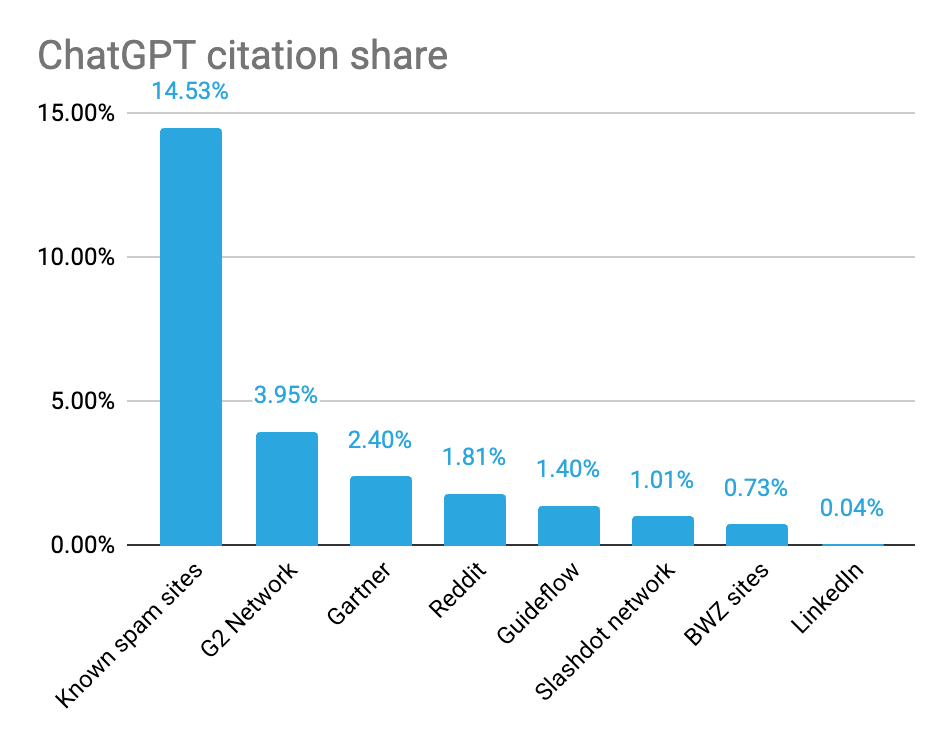
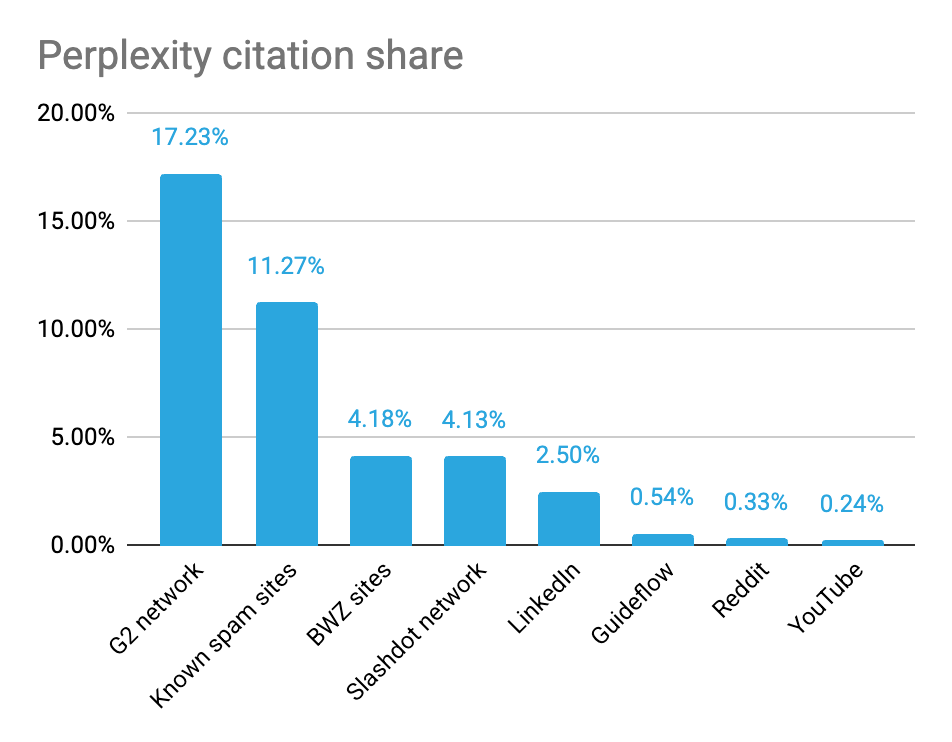
These sites account for 8.6% of the total citation pool, and it’s because ChatGPT and Perplexity cite them constantly. More than 14% of the citations ChatGPT returned in this experiment point to these domains. More than 11% of Perplexity’s citations do too.
Google-owned AIOs and Gemini responses don’t have this problem. AIOs only cite these domains a handful of times: just 0.16% of citations. And of all Gemini’s citations, only 0.46% direct people to these slop heaps.
What the heck is going on?
These sites pump out what Zoe has dubbed “phrase-match listicles”: articles programmatically generated from lists of potential exact phrases people (or LLMs) might search. This results in oodles of distinct rankings that no human would ever write, publish, or read.
For example, one of these sites has the following articles:
- Top 10 Best Slideshow Creator Software of 2026
- Top 10 Best Slideshow Creation Software of 2026
- Top 10 Best Slideshow Making Software of 2026
- Top 10 Best Slides Presentation Software of 2026
- Top 10 Best Slides Software of 2026
- Top 10 Best Slide Show Presentation Software of 2026
- Top 10 Best Slide Software of 2026
- Top 10 Best Slide Show Software of 2026
… and yes, there are even more. You get the idea.
There is no rhyme, reason, or consistency to the rankings or scoring on these pages. They’re simply full of references to tools that the bot writer decided belonged there. For example:
- Adobe Express is “best overall” in the “slideshow presentation software” article with a score of 9.3.
- But when it comes to “slides presentation software,” Canva takes the top spot with a score of 9.4—and Adobe Express doesn’t even make the list.
A human reader knows that a blog feed like this …
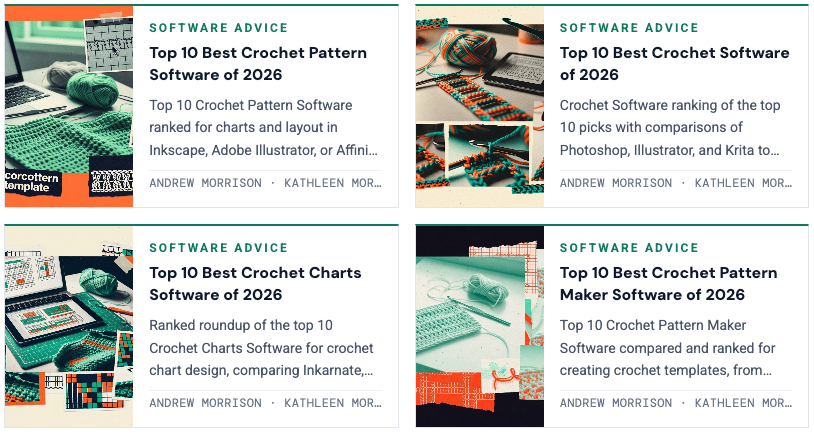
… is just silly.
But ChatGPT and Perplexity don’t. Both AI platforms clearly have a problem when it comes to vetting content sources. But the numbers tell a different story for each.
ChatGPT seems to be fooled at the URL relevance level. While there’s a lot of spam, a lot of these citations lead to places you’d expect: G2, Gartner, and Reddit. These sites are all likely to have at least one best-of-category page for any given type of software. However, these sites are incentivized to avoid Google penalties for redundant content—which is why you don’t see a dozen different Gartner directories for slide deck tools.
These spam sites aren’t worried about it. They’ve got a whole article dedicated to every conceivable “software” phrase that someone might type into ChatGPT. So when ChatGPT goes looking for answers, it sees (what looks like) hyper-relevant content on these spam websites. It’s hyper-relevant garbage, but it’s hyper-relevant nonetheless. Right now, ChatGPT keeps falling for it.
Perplexity seems to be fooled at the domain relevance level. Spam sites are the second most-cited group in Perplexity, right after the G2 network. After that, it’s Black & White Zebra’s network, then Slashdot’s sites. All of these sources claim authority at the domain level:
- G2 is a known source for software reviews, and so are their subsidiary sites (Capterra, GetApp, and Software Advice).
- Slashdot has been publishing tech news since the 90s, and SourceForge (same network) hosts a huge open source directory and tech community.
- BWZ runs blogs for specific types of buyers (e.g., CTOs, CMOs, etc.) giving each domain a general focus.
Likewise, all these spam sites call themselves trustworthy sources of research. They boast rigorous human editorial review processes, claim to be cited by well-known publications, and have long pages dedicated to describing methodologies and research offerings.
As of now, that seems to be good enough for Perplexity.
Is this sustainable?
Probably not. I have no idea how much longer it will be like this. It’s hard to imagine real buyers finding this slop helpful, but easy to imagine people simply using Perplexity to get a starter shortlist without vetting the sources.
Eventually, one of three things will happen:
- People will get fed up and stop using these platforms for building shortlists.
- The platforms will get better at vetting citations to prevent outcome #1.
- Enough people will remain totally OK with this and no change will be incentivized.
My guess: ChatGPT, Perplexity, and these other platforms will mature at about the same rate as exploiters will for a while. After all, these spam sites are using the same AI models to generate spam as buyers are to generate shortlists.
G2 gets cited more than any other website
G2 is the clear leader in citations for niche B2B solution discovery. G2.com is the single most-cited domain, earning 5.8% of total citations. When you add the citations earned by the other sites they own (Capterra, GetApp, and Software Advice), G2 network’s share of total citations rises to 8.0%.
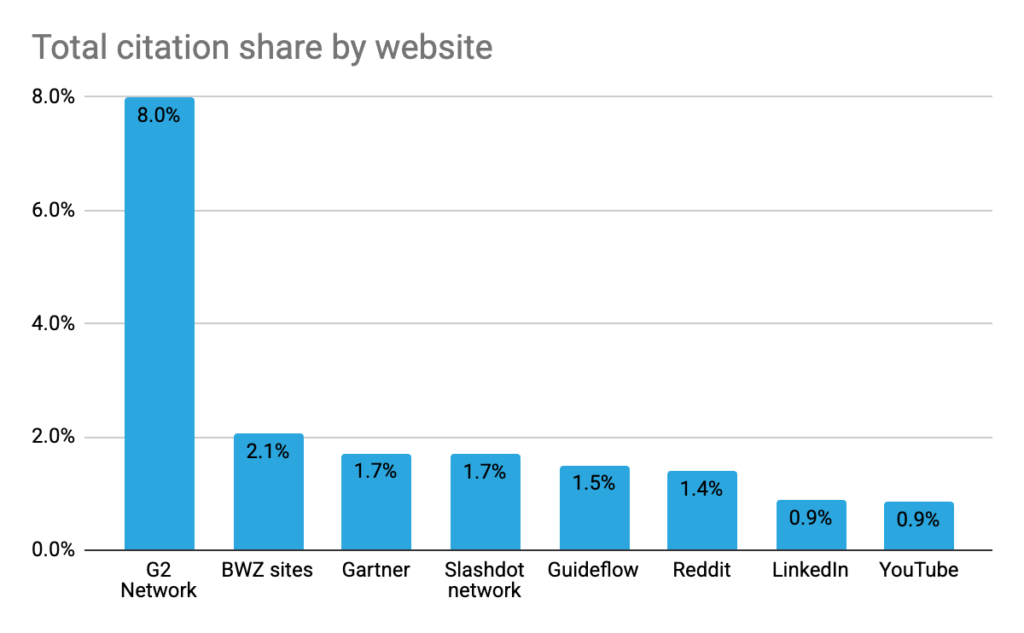
That’s almost as much citation share as the spam category (8.6%)! Yay?
G2 is a major citation source across all four channels. But it owes its massive lead to Perplexity, which contributed more than 71% of all the citations G2 earned in this experiment.
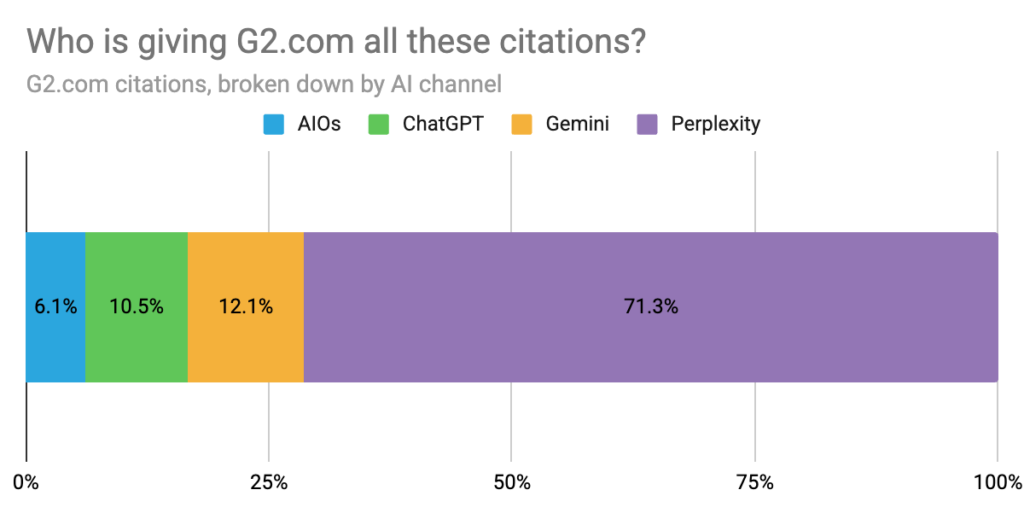
Like I mentioned earlier, Perplexity seems to play favorites at the domain-relevance level. When you ask Perplexity to recommend tools in a given category, it knows to check G2.
So if your audience uses Perplexity (a quick Sparktoro report will tell you if they do) your G2 hygiene should be an AEO priority. Make sure your profile and product descriptions are up to date. Make sure G2 has sorted you into the proper categories. Build G2 review requests into your customer success processes.
G2 has bet big on “algorithmic trust.” They’re heavily investing in making their platform the one LLMs reference—and right now it’s working. So make sure you’re taking advantage of it.
Wait … isn’t Reddit supposed to be the king of AEO?
I’ve been hearing “Reddit this” and “Reddit that” for over a year now. It’s often hailed as the best-performing domain in both traditional Google search and in tools like ChatGPT.
But in our experiment, Reddit only accounted for 1.4% of total citations. It’s the seventh most-cited domain overall, behind G2, Gartner, three spam sites, and Guideflow (whose content is also bot-written).
If we were running this experiment on general prompts, this might come as a shock. But given the nature of these prompts, I don’t think this should surprise anyone.
LLMs cite relevant Reddit threads. Reddit threads exist because real humans have something they want to discuss. But people don’t generally get on Reddit to discuss niche B2B software.
I’m painting with a broad brush here. Obviously, some professional communities are very active on Reddit. For example, a lot of the most-cited threads are discussing various categories of cybersecurity software—no surprises there.
But there’s not much human discussion around categories like earned value management software, staffing platforms, or translation management systems. Plenty of self-promotion, but little actual conversation.
Reddit gets a lot of attention in the marketing world these days. If you can maintain a rules-compliant community around your category, you might be able to influence LLM mentions and citations. But before you risk getting yourself banned, make sure that your category is something people would reasonably discuss.
Google’s AI tools are more likely to cite software vendors
After seeing so many spam sites in these citations, I wondered, “How many cited domains belong to companies actually selling relevant software?”
This experiment yielded 10,240 unique domains. I did not look at all of them.
But I did look at the top 100 domains by citation count in each of the four channels. The top 100 domains represent a tiny sliver (less than 4%) of unique domains cited across any channel, but account for a significant percentage of each channel’s total citations.
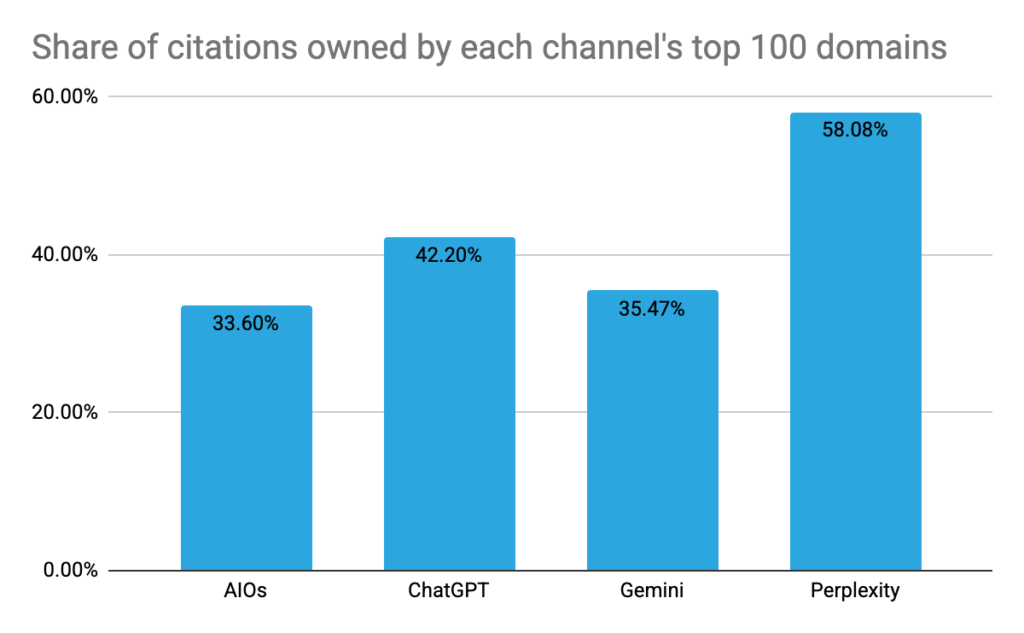
Then I went through the top 100 domains for each channel and tagged every one of them that was selling relevant B2B software.
The difference in vendor representation between Google-owned AI tools and the others is stark.
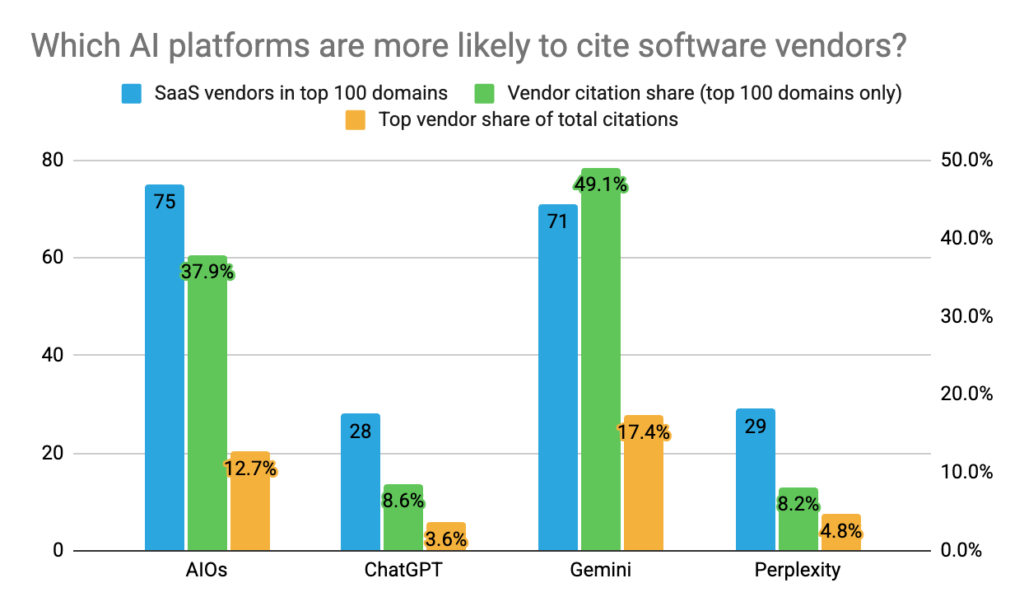
No platform gives vendors a majority of citations. But in terms of the top 100 domains, Google AIOs and Gemini are far more likely to cite actual vendors than ChatGPT and Perplexity. The split looks almost engineered: about three-quarters of the top domains are vendors in Google’s tools, whereas about three-quarters are NOT vendors in the others.
AIOs cite YouTube more than any other domain
I mentioned this in our Q2 report on niche SaaS search, but it fits here too: no other domain comes close to YouTube in AIO citations. You’ve probably already experienced this first-hand: Google’s quick to slap a YouTube preview at the top of a SERP.
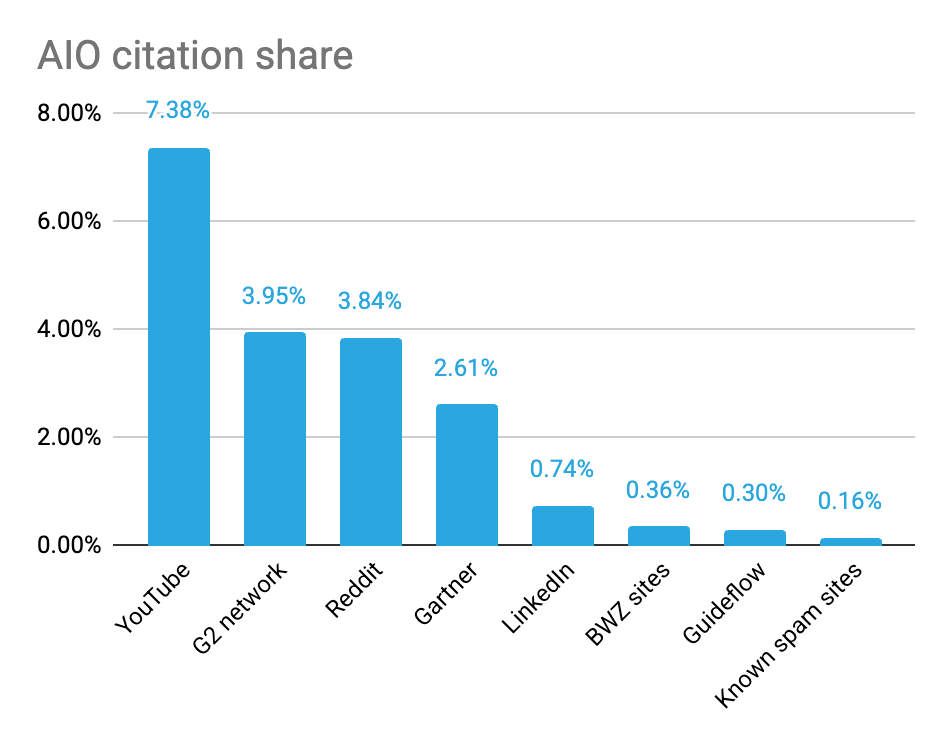
The quality of these video results is … mixed.
Some of them feature real humans delivering real thoughts on software categories. Some of them are clearly humans reading a teleprompter. Some of them are AI avatars reading blog posts aloud. We’ve even got AI-interviewing-AI synthetic podcasts. Google is far better at filtering out written slop than the other platforms, but it still has a long way to go when it comes to keeping video slop out of the results.
Which means in the niche B2B SaaS world, video quality is not a barrier to AIO visibility. You don’t need high production quality. Heck, your videos don’t even have to be remotely good. All it takes is one real human willing to go on-camera in order to stand out in most of these B2B categories.
At this point, you might be thinking:
- If Google accounts for 73.7% of all desktop search …
- And if 76% of solution-aware B2B searches result in an AIO …
- And if YouTube videos are consistently favored by AIOs …
- Then making a YouTube video is a pretty easy way to get visibility, right?
That depends on what you mean by “visibility.”
Google plugging a video in AIOs is no guarantee of video views. In a small eye-tracking study (22 participants performing 9 searches), videos that appeared in AIOs got a lot of attention—people noticed them about 95% of the time. However, the CTR on these AIO videos was only 20%.
But marketers shouldn’t think of video watches as the end-all here. For example, Google AIOs can display a video’s thumbnail, title, and channel name, like the one below from Heimdal.
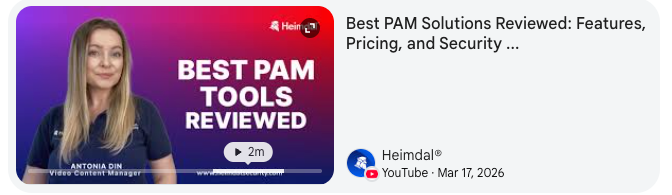
This video thumbnail shows a real person, their position at the company, the topic of the video, and the company logo. As I’m writing this, the video itself only has about 260 views—but it puts Heimdal’s brand in a place that gets attention.
Aleyda Solís summarized attention-grabbing, low-CTR AIO features well: “their value lies in branding or visibility, not in driving traffic.”
What does this mean for marketers?
My bet is that buyers will get tired of this spam problem before these tools get their acts together. So here’s what I’d recommend doing with this information.
- If you want the bots to mention you, you need to get mentioned elsewhere. At the bare minimum, you should make sure your own website, G2 profile, and other online company profiles consistently mention what your product does and what its category is.
- Listicles may not be the future, but they are the now. Today, it’s probably more useful for your brand to show up anywhere in 10 offsite spam listicles than it is for you to be #1 on your own list. However, your own website is where you’ll have the most control over what the LLMs ingest. I’ve seen owned listicles generate visibility for small startup players in crowded, incumbent-heavy spaces—but there’s an art to making a listicle with any staying power.
- Your YouTube channel is a big visibility opportunity. Google is rewarding terrible videos with exposure, just because they exist. It is not hard to do better. But remember, the main thing you can expect to get from AIOs is brand visibility, not video views. Optimize your thumbnails accordingly.
- Don’t treat “AI” like a single channel. We can see that each of these four tools has its own biases. If you’re reporting on AI visibility without examining the individual channels, you risk muting the real insights to be found. For example, YouTube accounts for less than 1% of total citations across the board—I only noticed how well they perform in AIOs by looking at each channel individually!
- The consideration stage is full of empty noise. It’s still important to publish your own branded content to inform this stage, but I think strategic marketers know this is not an easy place to stand out. If you want to actually win the eyes and ears of the market, you’ll have to move up-funnel and create something worth people’s attention.
It’s a spammy, sloppy world out there, folks. We can do better.
Experiment methodology
Here’s the process we went through in order to get the data in this report:
- First, Zoe and I scraped G2’s software categories.
- We plugged these product categories into Ahrefs as keywords and looked at the resulting data.
- We clipped those product category keywords based on two criteria:
- It had to be a product category that could reasonably qualify as B2B.
- It had to reasonably qualify as “niche,” which for this report meant it had 150–700 monthly organic searches.
- This left us with 250 niches mapped to 17 high-level B2B SaaS groups:
- Analytics Tools & Software
- CAD & PLM Software
- Collaboration & Productivity Software
- Commerce Software
- Content Management Systems
- Customer Service Software
- Data Privacy Software
- ERP Software
- Governance, risk & compliance software
- HR Software
- IoT Management Platforms
- IT Management Software
- Marketing Software
- Office Management Software
- Sales tools
- Security Software
- Supply Chain & Logistics Software
- We iterated our keywords so that every keyword had the following variants, giving us a total of 1,000 keywords:
- [PRODUCT CATEGORY]
- Best [PRODUCT CATEGORY]
- Enterprise [PRODUCT CATEGORY]
- Best [PRODUCT CATEGORY] for enterprises
- We ran an Ahrefs report on those keywords. Of the 1,000 keywords, 264 triggered an AI Overview.
- We fed the AIO keywords to Amadora, an AI visibility tracking tool, to track AIO responses and citations on these keywords for a week.
- We also iterated a set of 1,000 prompts to feed into ChatGPT, Gemini, and Perplexity via Amadora. These prompts were applied to all 250 software product categories:
- “What is the best [PRODUCT CATEGORY]?”
- “What is the best [PRODUCT CATEGORY] for enterprise teams?”
- “I’m researching [PRODUCT CATEGORY] for my team. What vendors belong on my shortlist?”
- “I’m building a list of potential [PRODUCT CATEGORY] options for my team. What are the most important factors and capabilities I should look for as I build my shortlist? How would you recommend I go about choosing the ideal option for my team? A few things to keep in mind: I need clear criteria/rationale for this decision, it needs to perform at the enterprise level, and you can ignore price at this point.”
- We ran this test during the same week we were tracking AIO responses.
- Once the test was done, we gathered the data and pulled out the results you see here.