
Since March, Zoe and I have analyzed a basket of 1,000 B2B SaaS SERPs across 250 unique, niche product categories on a monthly basis. This report gives you an idea of how Google’s treating solution-aware keywords in smaller software markets.
If you’re a B2B SaaS marketer trying to get on enterprise buyers’ shortlists, we made this report for you. (And if you want more hands-on help or insights on your particular vertical, drop me a line!)
B2B SEO stats for June 2026
Here’s what we found looking at the entire index.
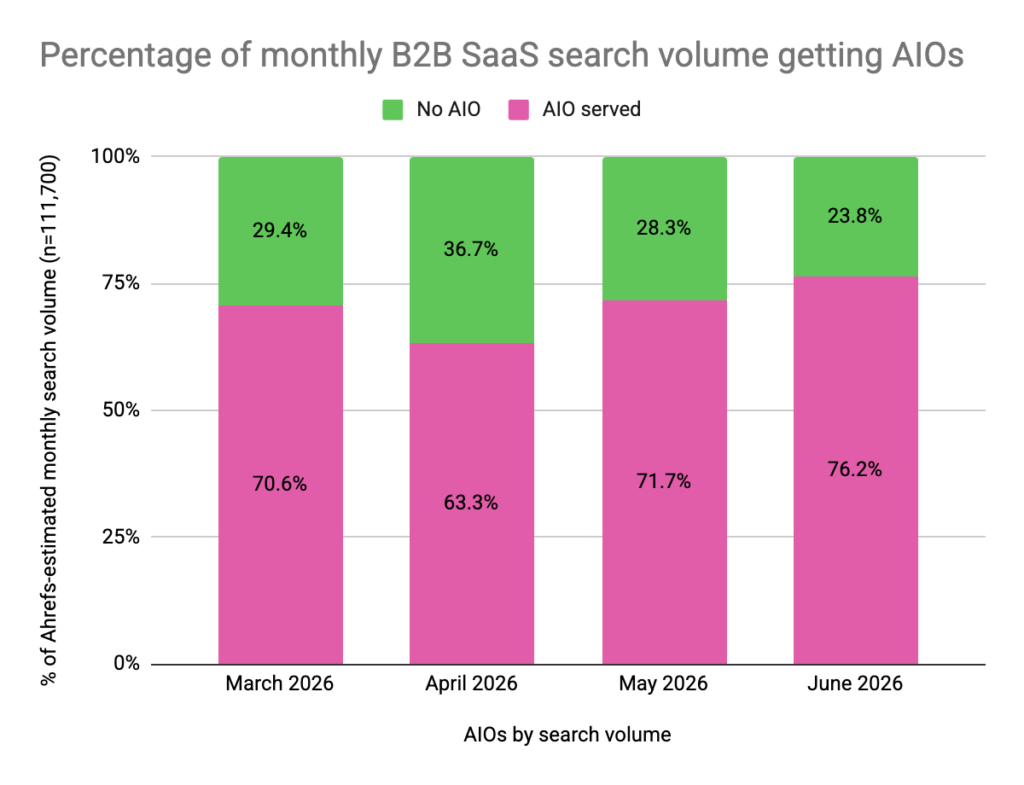
- More than 76% of solution-aware Google searches now result in an AI Overview (AIO).
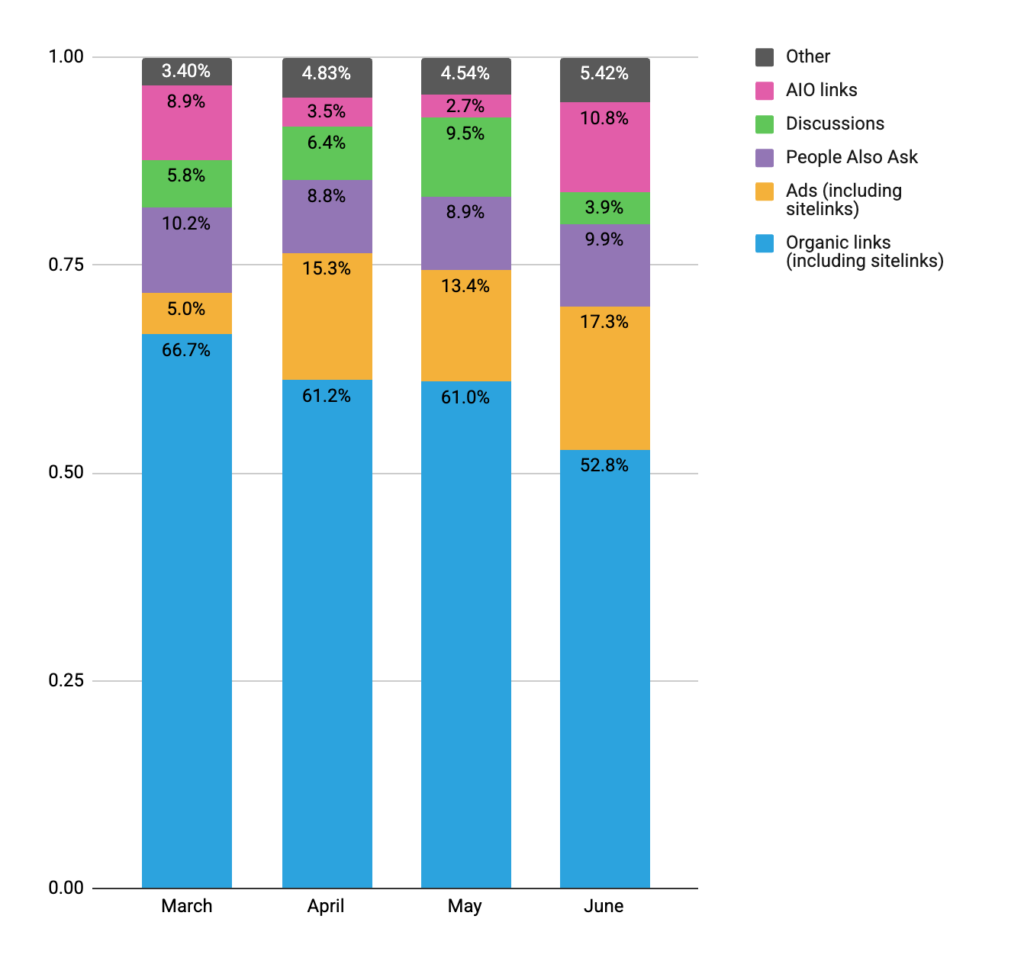
- AIO links have rebounded from May lows: almost 11% of all search results are now links in AIOs.
- YouTube is the most-cited domain in AIOs (and it’s not even close).
- Organic links now account for only 52% of search results.
- Ads grew to 17% of all search results.
- After wild growth, Google slashed “Discussions and Forums” features down to 3.9% of results.
- Reddit’s SERP share shrank to 6.9%—close to half of what it was in May.
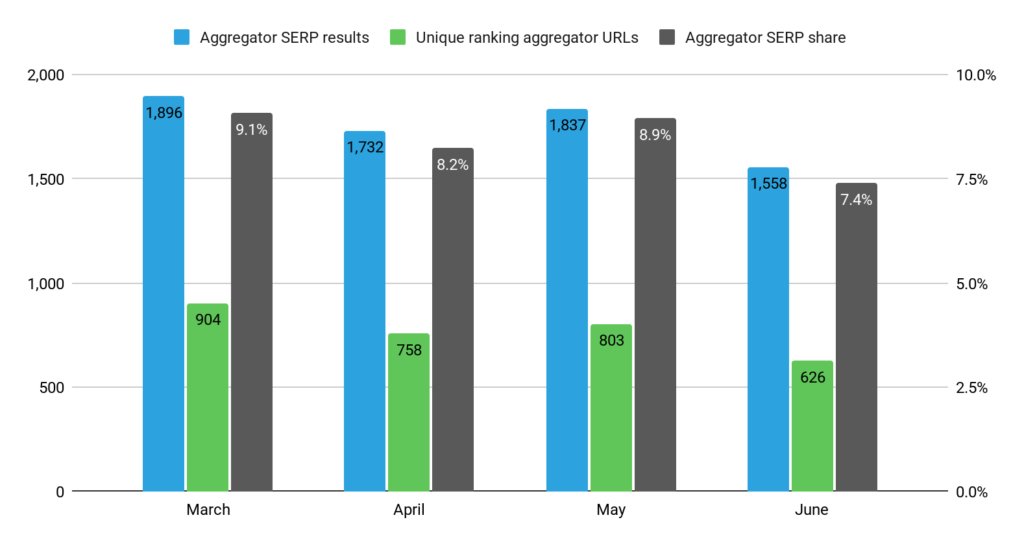
- Review aggregators (Gartner, G2, TrustRadius, etc.) lost 17% of SERP share.
Keep in mind: all of these numbers are based on the keywords and prompts in our index. SERPs vary from category to category, but this report provides an overarching look at the world of B2B SaaS search visibility.
If you’re curious how we built this index, I’ve described our methodology at the end of this article.
Now let’s look at the big findings!
76.2% of B2B solution-aware Google searches now get AIOs
This is the first time AI Overview search presence has crossed the three-quarters threshold since we started tracking this index in March.
AIOs only appeared for about a quarter of the keywords we tracked (27.1%, to be exact). However, most of the search volume in this index was tied to SERPs with an overview. AIO presence seems moderately connected to search volume—the correlation coefficient between the two is 0.69.
More ads, AIOs, and PAAs; fewer organic and discussion links
Last month, “Discussions and forums” SERP features exploded, racking up a whopping 9.5% share of total search results—even though many of those “discussions” were old, empty, obvious SEO grabs, or all of the above.
That didn’t last long. Discussions are down to only 3.9% of the results share. In fact, they’ve pretty much swapped places with AIO links, which have really taken off (more on that next).
“People Also Ask” boxes saw some growth in share, as did ads.
But all that SERP feature expansion has to come from somewhere. Organics are down, barely taking up more than half of the results this month.
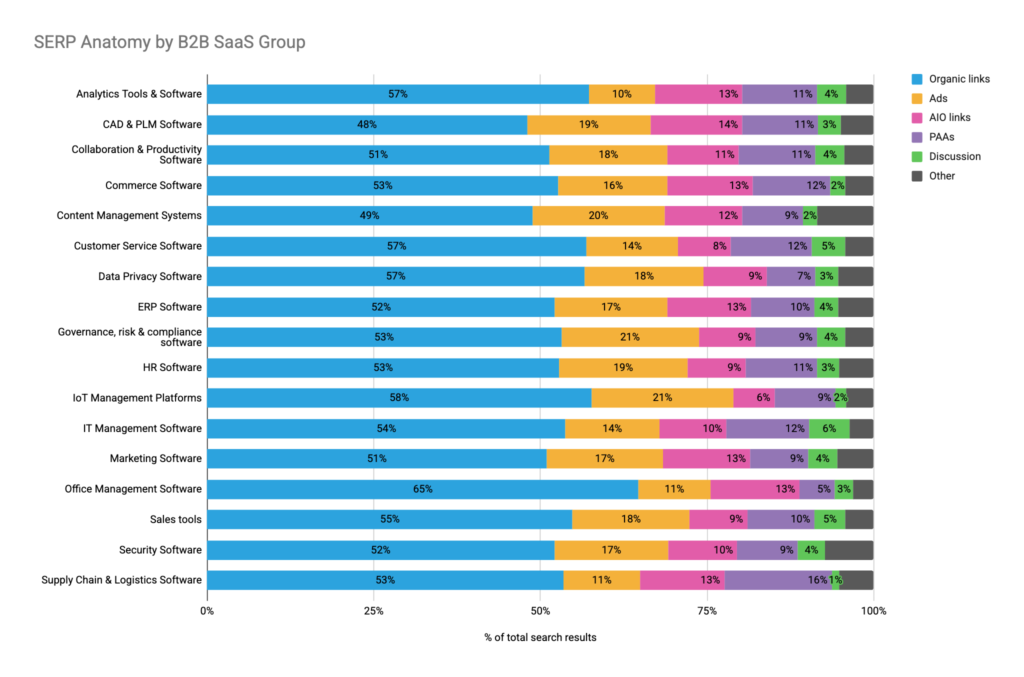
Of course, this is index-wide. SERP anatomy shakes out differently at the category level. Organics hold around half the SERPs across the board. But between ads, AIOs, and PAAs, the number two spot changes hands from category to category.
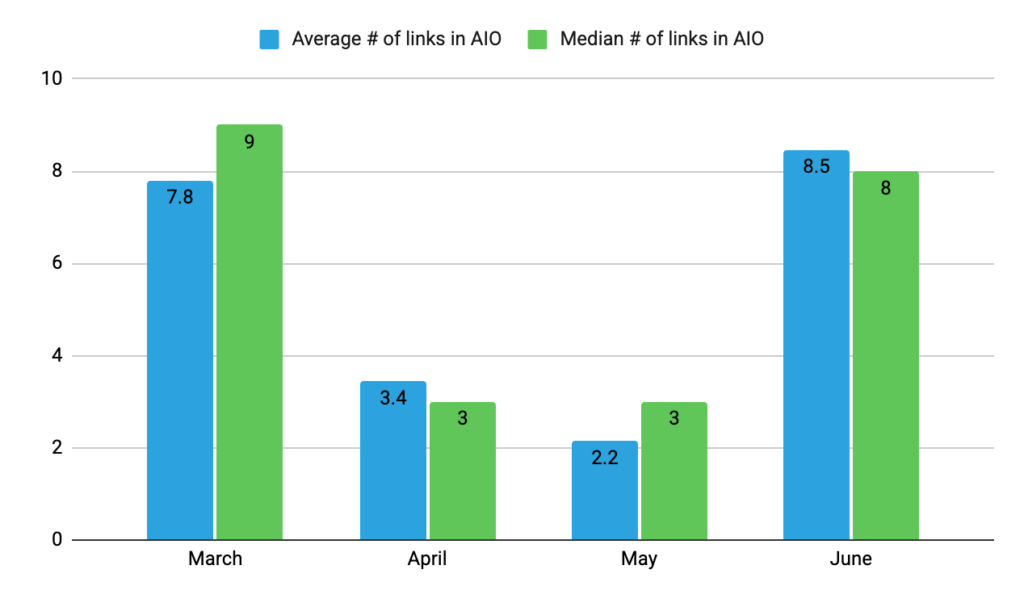
As of June 2026, the average AIO contains about 8 links
It wasn’t that long ago that “ranking #1” for a keyword meant that your result was the first thing people saw when they ran that search.
Things have changed. Today, the “top” organic result could be eight links down the page—maybe even more.
When we ran our first report in March, the average Google AI Overview included 7.8 links. These included citations, thumbnails, videos—all that clickable stuff. By May, they were down to two.
And now they’ve rebounded. The median AIO contains 8 links, and the average is slightly higher at 8.5.
As you know, not every link in an AIO is immediately visible. You usually need to expand the overview to see all the links it includes. But it’s important to recognize that AIOs, which shift all the time, are fundamentally changing what it even means to rank anymore.
Behold, YouTube: the darling of AIO links
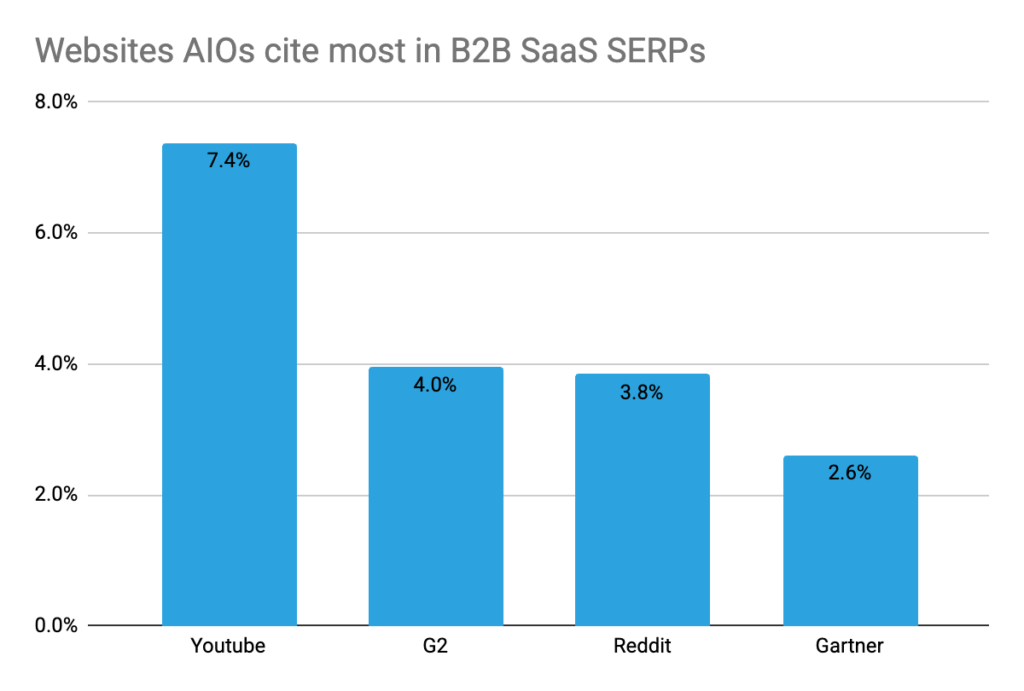
We ran the keywords with AIOs through Amadora for a week to see which domains Google’s AIOs cite most, and we found a clear winner: 7.4% of all AIO citations point to YouTube. In fact, almost half of the YouTube SERP results in this index live in AIOs.
G2 (4.0%) and Reddit (3.8%) come next, with Gartner rounding out the top four with 2.6% of total citations.
As Ross Simmonds tweeted a few days ago:
“YouTube will likely be at the top of the SERP for every high-value query you can think of in the next 12 months. […] Yet most of these companies STILL treat YouTube like a dumping ground for podcasts, webinars and mediocre product tutorials.”
He’s right. YouTube is not just a place to park your old commercials, about-our-culture videos, and product tours anymore. I see it popping up more and more in B2B search. The numbers might fluctuate, but I doubt we’ll see less YouTube in these categories over time.
For the love of marketing, get YouTube into your content strategy! You can start by adapting your most popular blog posts into videos. They don’t have to be extremely high in production value. I’ve seen voice-over-screenshare videos, talking heads, and even deadpan text-to-speech robo-readers showing up in AIOs. Just like with Discussions, videos don’t even need to be good in these product categories—Google rewards them for simply existing.
Review site SERP share declined by 18.5% in Q2
If you’ve ever Googled anything about your product category, you’ve probably noticed that Gartner, G2, Capterra, and other review sites have a very visible presence. This is still true today, but that presence seems to be steadily shrinking.
From March to June, review aggregator sites lost 18.2% of their SERP share, falling from almost 9.1% to 7.4%. As the chart below shows, this isn’t a straight-line decline. SERPs fluctuate from month to month. However, the trend seems to be pointing downward.
I took a closer look at how the two big players here (Gartner and the G2 network) have fared over the past quarter. Again, the numbers fluctuate from month to month, but both entities’ shares of total search and organic links are in mild decline.
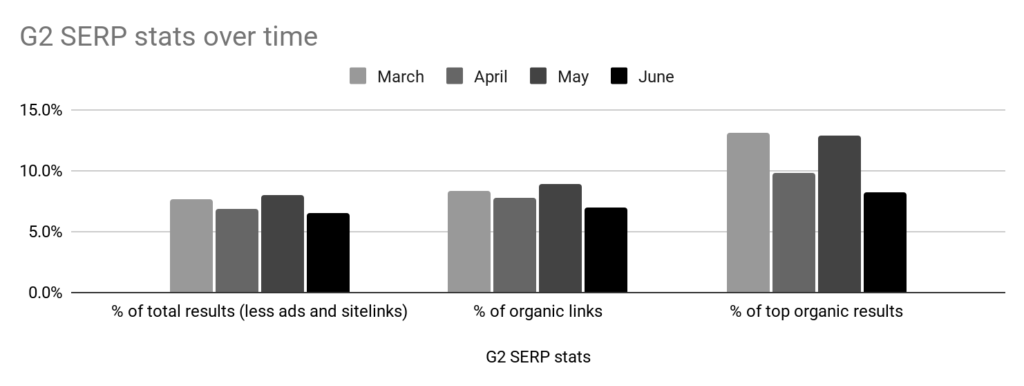
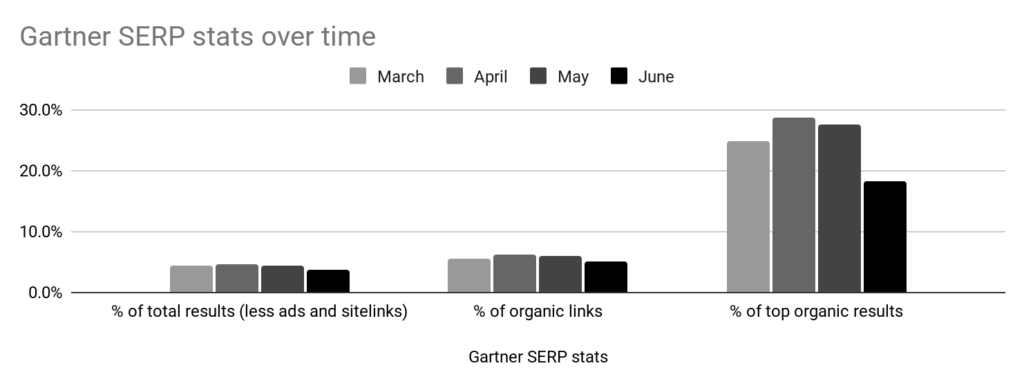
But make no mistake: G2 and Gartner have respectively held spots #2 and #3 in terms of share of total results all quarter. When you look at strictly organic results, they’re in first and second. And if we look at the share of top organic positions (the first blue link you see after all the AIO and ad content), Gartner has been untouchable the whole time.
Bottom line: any consideration-stage visibility strategy needs to account for Gartner and G2. These companies have built domains that search engines and LLMs trust. Whatever’s published on these sites is going to factor into what people learn (or don’t learn) about your products. Start by making sure your profiles are up to date. Then set up systems that keep your customers aware that they can review your products there.
About the Niche B2B SaaS SERP Index
Marketing leaders are under pressure to figure out how they’ll handle search in the age of AI. If you’ve felt like that conversation is pulling you in ninety-six directions at once, I feel you.
Most of the SEO community is talking about AI search and visibility at a general level.
That’s kind of like reading about the average temperature across your country: it’ll give you the big picture, but it won’t tell you if you need to bring an umbrella to work today.
What matters more than the large-scale changes in search is the SERPs in our own product category verticals right now.
So Overthink Group General Manager Zoe Tjoelker and I created our own niche B2B SaaS SERP index. This is a basket of 1,000 SERPs for solution-aware keywords related to 250 niche software product categories from G2’s database. We’re looking specifically at what people see when they Google low-volume, solution-aware keywords.
Think of this as the local SEO weather report for B2B SaaS.
Study methodology
OK, let’s talk about where these numbers come from.
- First, Zoe and I scraped G2’s software categories.
- We plugged these product categories into Ahrefs as keywords and looked at the resulting data.
- We clipped those product category keywords based on two criteria:
- It had to be a product category that could reasonably qualify as B2B.
- It had to reasonably qualify as “niche,” which for this report meant the category itself, (e.g., “IoT device management platforms”) had 150–700 monthly organic searches.
- This left us with 250 niche categories grouped in 17 high-level B2B SaaS factions:
- Analytics Tools & Software
- CAD & PLM Software
- Collaboration & Productivity Software
- Commerce Software
- Content Management Systems
- Customer Service Software
- Data Privacy Software
- ERP Software
- Governance, risk & compliance software
- HR Software
- IoT Management Platforms
- IT Management Software
- Marketing Software
- Office Management Software
- Sales tools
- Security Software
- Supply Chain & Logistics Software
- We iterated our keywords so that every keyword had the following variants:
- [PRODUCT CATEGORY]
- Best [PRODUCT CATEGORY]
- Enterprise [PRODUCT CATEGORY]
- Best [PRODUCT CATEGORY] for enterprises
(For the record, I do NOT believe ranking for keywords like these is always the most important thing for a content strategy to focus on. But they are the types of keywords your CEO, head of sales, investors, and board members probably expect any SEO team to have on their radar.)
- We pulled the top 10 SERP results from every keyword via Ahrefs
- If a keyword triggered an AIO in Ahrefs, we used Amadora to track that keyword in Google AIOs for a week. This is how we got those citation share numbers for the YouTube glaze part of this report.
- And then I wrote this. =)